

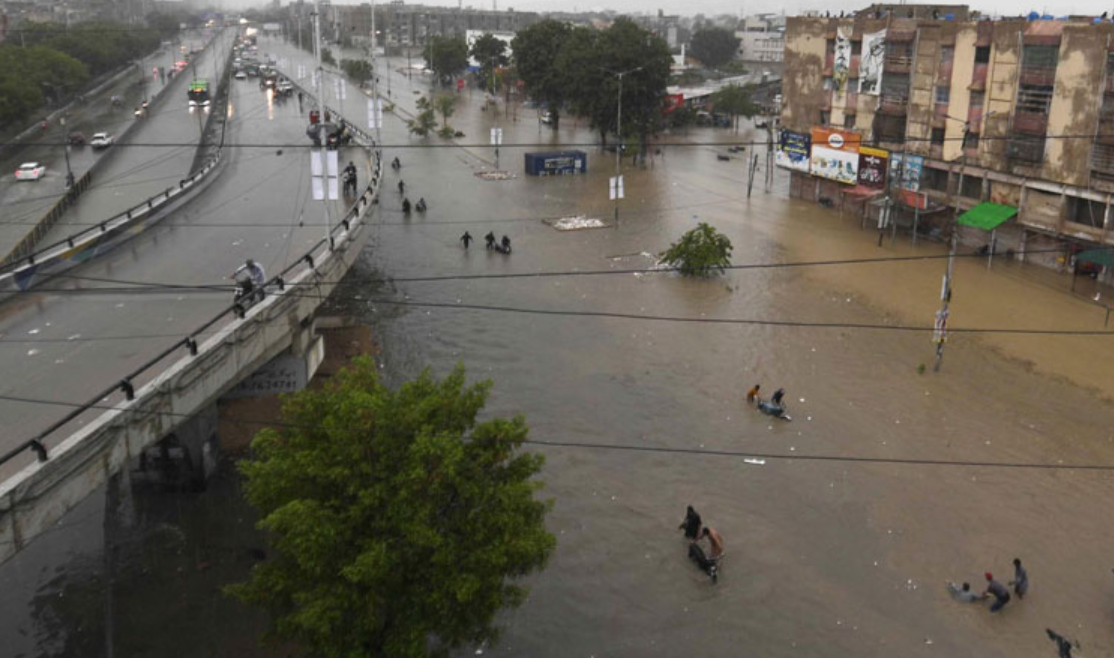

The port city of Karachi has been battered by relentless monsoon rains for a second consecutive day, causing widespread flooding, traffic gridlocks, and long-lasting electricity outages. What began as heavy downpours on Tuesday has intensified, leaving major roads submerged and daily life at a virtual standstill.
Streets Flooded and Traffic Disrupted
Multiple neighborhoods and commercial hubs were heavily affected, including Shah Faisal Colony, Saddar, Liaquatabad, Federal B Area, Clifton, Defence, Nursery, PECHS, Burns Road, Tariq Road, Jodia Bazaar, and Shahrah-e-Faisal. The rainfall created severe waterlogging on key arteries, making commuting nearly impossible.
Authorities confirmed that seven underpasses across Karachi had to be closed due to rapidly rising water levels. Karachi Traffic Police reported major closures in District East (Shaheed-i-Millat Road Underpass, Tariq Road Underpass, and Drigh Road Underpass leading to the airport). In District Central, underpasses at Nazimabad No. 1 and 2, Liaquatabad No. 10, and Gharibabad were also sealed off.
Commuters were stranded for hours, with public transport services heavily delayed and private vehicles left stuck in waist-deep water.
Weather Forecast and PMD’s Warning
According to the Pakistan Meteorological Department (PMD), thunderstorms and showers will continue until August 23 across Sindh, with intense cloudbursts more likely in hilly areas. Deputy Director Anjum Nazeer Zigham confirmed that the rains which began in the afternoon would persist until evening, especially in Karachi’s northeastern belt.
Climate Change and Mayor’s Response
Karachi’s Mayor Murtaza Wahab acknowledged the city’s dire situation, highlighting that extreme weather events linked to climate change are not unique to Karachi but have also devastated regions like Azad Kashmir, Khyber Pakhtunkhwa, and Gilgit-Baltistan.
During a press briefing, Wahab revealed that Manghopir recorded 235 millimeters of rain in Tuesday’s storm alone — one of the heaviest single-day downpours in recent memory. His conference was interrupted as fresh rainfall resumed, underscoring the city’s ongoing crisis.
Human and Material Loss
The destructive storm has already claimed 11 lives, prompting the Sindh government to declare a public holiday in Karachi. Courts and offices remained closed, yet recovery remains sluggish.
Residents reported that:
-
Electricity outages continue in multiple neighborhoods, leaving families struggling in sweltering heat and humidity.
-
University Road has developed deep potholes, posing risks to motorists.
-
Vehicles submerged in floodwater remain abandoned along major routes.
The tragedy is not only human but also infrastructural, as Karachi’s drainage system once again proved insufficient to handle monsoon downpours.
Social Media Updates and Safety Advisories
On social platforms, the Mayor urged citizens to avoid Shaheed-i-Millat Road due to ongoing clearance operations in submerged underpasses. Authorities continue to deploy suction pumps and rescue teams, but progress has been slow given the volume of rainfall and clogged drainage lines.
Despite efforts, the city remains paralyzed, with stranded commuters, halted traffic, and disrupted daily routines. Citizens now brace for additional downpours in the coming days.
Outlook: More Rain Ahead
As Karachi faces continued rain through August 23, residents are being advised to:
-
Stay indoors whenever possible.
-
Avoid traveling through waterlogged underpasses and major thoroughfares.
-
Prepare for possible extended power cuts.
The heavy rains in Karachi once again expose the urgent need for better urban infrastructure, effective drainage systems, and climate resilience planning. Without such measures, Pakistan’s largest city will remain vulnerable to repeated flooding disasters each monsoon season.
