

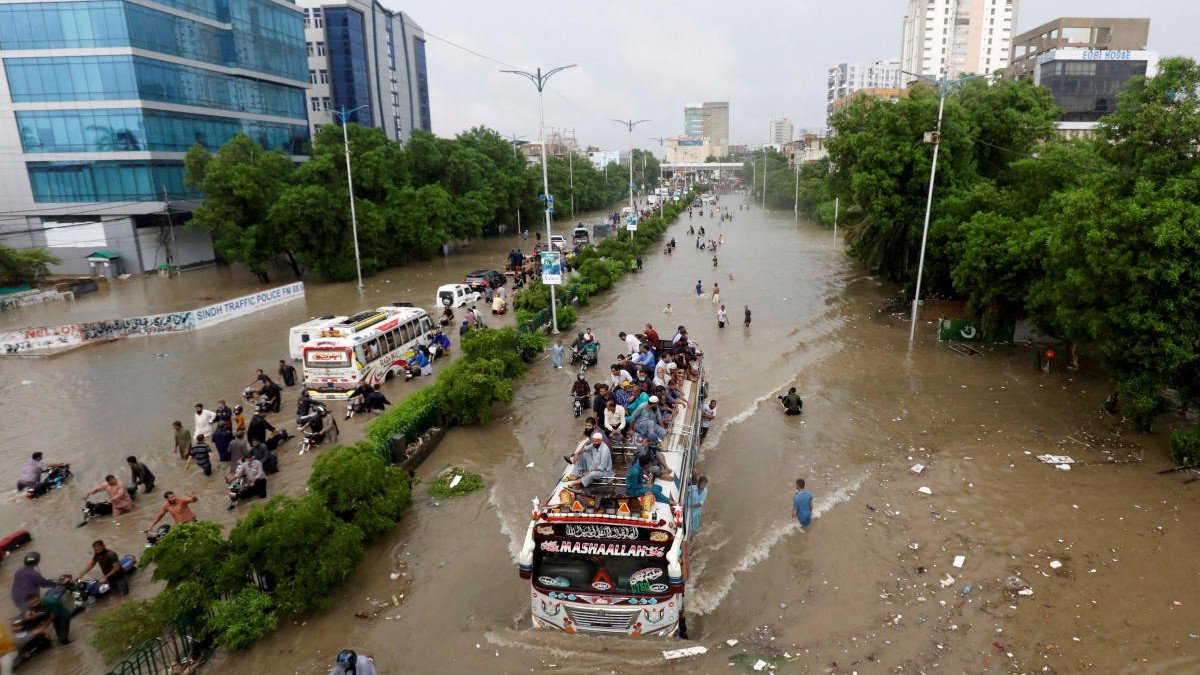

The death toll from the ongoing monsoon floods in Pakistan has risen to 660, with widespread destruction reported across the country. The heaviest casualties occurred in Khyber Pakhtunkhwa (KP), where 392 people lost their lives, followed by Punjab with 164 fatalities.
Other affected regions include Gilgit-Baltistan (GB) with 32 deaths, Sindh with 29, Balochistan with 20, Azad Jammu and Kashmir (AJK) with 15, and Islamabad Capital Territory (ICT) with eight, according to the National Disaster Management Authority (NDMA).
Among the victims, 394 were men, 95 women, and 171 children. In addition to the fatalities, at least 935 people were injured nationwide, with Punjab reporting the highest number of injuries at 582, followed by KP with 245, GB with 37, Sindh with 40, AJK with 24, Balochistan with four, and ICT with three. The floods have also caused extensive housing damage, with 2,478 homes affected across the country.
KP reported 212 fully destroyed and 500 partially damaged houses, while GB recorded 368 fully destroyed and 229 partially damaged homes. In AJK, 152 homes were completely destroyed, with 567 partially damaged. Punjab, Sindh, Balochistan, and ICT also suffered significant structural damage, with hundreds of homes either fully or partially destroyed.
The devastation has been particularly severe in KP cities such as Peshawar, Mardan, Swabi, Abbottabad, and Buner. Torrential rains triggered flash floods and landslides, sweeping away vehicles and homes. In Swabi, a cloudburst claimed 15 lives and submerged homes, while two people drowned in Colonel Sher stream. Landslides have blocked roads, complicating rescue efforts, and locals have called for air evacuations.
In Mardan, entire neighborhoods were submerged, and in Abbottabad, landslides affected multiple areas, including the Galiyat region. In Buner, schools were washed away, leaving scattered furniture and books, while relief operations were hampered by the persistent rain.
Punjab also experienced heavy rains, with low-lying areas of Chakwal and Kallar Kahar submerged. Floodwaters in Nala Ghabir and the Indus River at Rajanpur forced evacuations in nearby villages. In AJK, multiple incidents were reported, including the death of Dr. Gul Lala, who was swept away in Nala Tarar, and five people drowning after a car plunged into the Neelum River in Athmuqam Grace Valley.
In response, KP Chief Minister Ali Amin Gandapur announced salary donations from himself, cabinet members, lawmakers, and provincial staff to support relief efforts. A special PDMA account will ensure transparency in fund utilization. The federal government has directed ministers to visit affected areas in KP, AJK, and GB within 24 hours to monitor relief operations.
Prime Minister Shehbaz Sharif pledged full federal support for rehabilitation and declared aiding flood victims a national duty. Authorities are urging evacuations from stormwater-prone areas while mobilizing emergency services and resources to restore connectivity, provide medicines, and assist the displaced population.
The combined efforts of provincial and federal authorities, alongside relief organizations, aim to mitigate the effects of the disaster and ensure timely rehabilitation for those impacted by one of the most devastating monsoon seasons in Pakistan’s recent history.
