

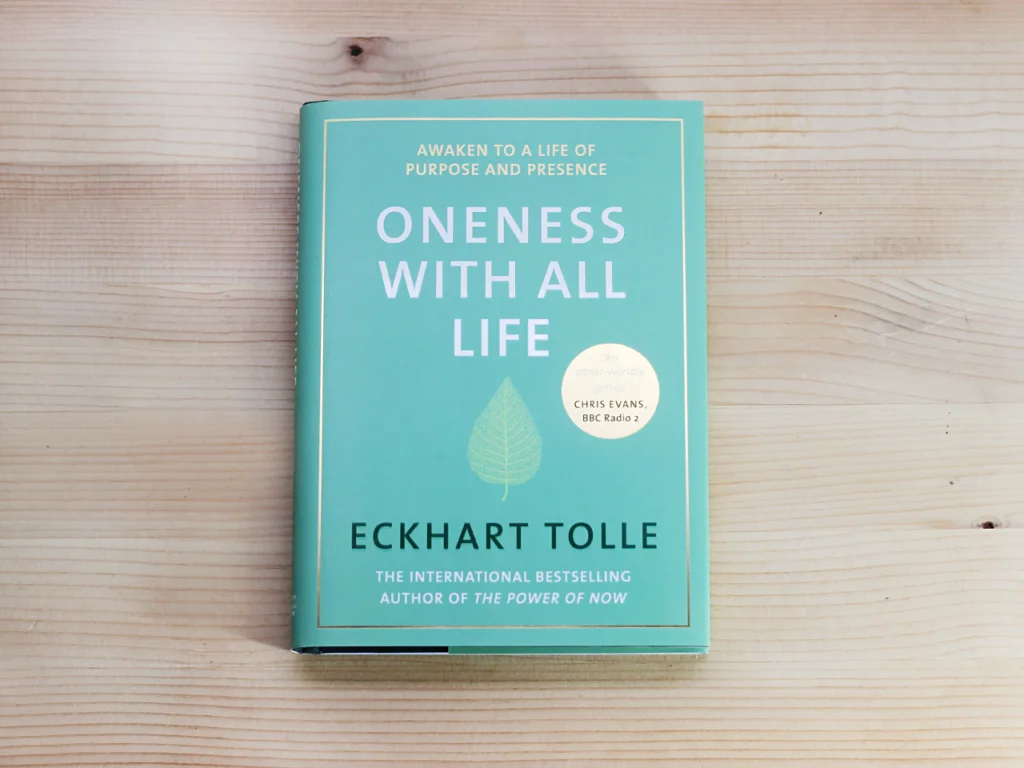

If you are an ardent reader of self-help books and have grown weary of the repetitive advice and overused expressions that dominate much of the genre, then Eckhart Tolle is definitely your cup of tea. His writing offers something deeper, something that bypasses the surface-level motivation so many modern authors seem to rely on. Tolle believes that man himself is the key that can unlock the mysteries of this universe — not external circumstances, not other people, and not even the accumulation of knowledge in the conventional sense. His philosophy points inward, insisting that the answers we often search for in the outer world are already within us, waiting to be realized once we learn how to connect with the deeper dimensions of our own being.
Eckhart Tolle’s book, Oneness With All Life, is an associate volume of his ground breaking work, A New Earth. The connection between the two is profound, as Oneness With All Life condenses and distills many of the essential principles Tolle has become known for. It is one of those rare books that needs not only to be read, but also chewed and digested — much like the essays of Francis Bacon, which require patience and reflection to fully appreciate their layered meaning. The book is a condensed form of writing that deals with how one can bring the unconscious into consciousness in order to unify oneself with existence. Rather than being a quick read to tick off a list, it is a text that calls for engagement, contemplation, and perhaps even re-reading to truly absorb its transformative insights.
Going Beyond Thought:
Tolle emphasizes how minute an aspect of Being thought actually is. While most of us live as though our thoughts are the entirety of who we are, he reveals that thought is merely a ‘belief system’ — a mental construct that classifies and taboos situations as good or bad. Why does this happen? Because the mind, by its very nature, likes order. It seeks patterns, categories, and judgments to make sense of the chaotic flow of life. Yet in doing so, it limits our perception of reality. Only by rising above thoughts, by stepping into the silent awareness that observes them, can one truly liberate and identify oneself. In this light, thought becomes not the master but the servant, and the deeper truth of our being begins to emerge.
The Power of the Present Moment:
According to Tolle, ego is the arch enemy of the present moment. The ego resists what is happening, preferring to dwell in past grievances or future anxieties, because the present moment offers no fuel for its endless narratives. The way we receive and treat our present is crucial. If we approach it as an obstacle, something to be endured until a supposedly better future arrives, we deviate from our destiny and disconnect from life itself. Our consciousness of the present moulds our reality in the present — and therefore shapes what is to come. The present moment is not simply a slice of time; it is the only point of access to the life force that animates everything.
Who Am I?
Tolle introduces the concept of ‘detachment’ in every aspect of life so that one can have a clearer version of Oneself. Detachment, in his usage, does not mean apathy or withdrawal from life; rather, it is the freedom from over-identifying with roles, possessions, and personal stories. According to Tolle, identity is woven into existence with ego, which hinders one’s path to understanding the reason for creation — to know Oneself. This knowing is not intellectual but experiential, and it is only achievable once one is liberated from everything, including time itself. By loosening the grip of labels and narratives, a person begins to sense the vastness of their own consciousness beyond the confines of form.
Awakening:
In this chapter, Tolle speaks of how inner awareness is coherent with universal intelligence. This is not a poetic metaphor but an actual alignment — the individual consciousness recognizing its inseparability from the whole. Awareness of oneself, he notes, is often evolved through suffering. Far from being meaningless or purely destructive, suffering has a noble purpose in Tolle’s view: it destroys ego and enlightens one’s consciousness. Pain can strip away illusions, forcing us to confront what is real and essential. Through such trials, a deeper awakening occurs, revealing the stillness and peace that were always present beneath the turbulence of life.
Inner Space:
Consciousness that is void of thought is what Tolle refers to as inner space. He further delves into the concept of space consciousness, which is a state of pure awareness that is not cluttered with mental noise. Consciousness of one’s own presence, irrespective of material belongings and identity, enables one to rise above thoughts and access a more expansive dimension of being. This is not mere passivity but the evolution of human existence — a shift from compulsive thinking to spacious awareness. In space consciousness, all self-created happiness and suffering come to an end because both are rooted in identification with thought and form.
Your Life’s Purpose:
Our primary purpose in life, Tolle explains, is to attain an internal state of consciousness. Without this inner shift, all external changes are mere acts of ego — busy rearrangements of the surface while the underlying patterns remain the same. How does one attain consciousness? Simply put, by choosing acceptance over resistance, and allowing the joy of life to flow from deep within rather than depending on external circumstances. The ego’s wants are endless and insatiable, but the joy that arises from consciousness is self-sustaining. By living in alignment with this inner purpose, the outer purpose — whatever form it takes — becomes infused with clarity and peace.
Becoming Present:
To be entirely present, one must keep a watchful eye on the trail of thoughts that constantly pull attention into the past or the future. A present person, in Tolle’s description, is both still and alert — grounded in the moment yet fully aware of the world around them. This state of being does not dull life; rather, it heightens its vividness. For a person to be completely in tune with the present, they must be at peace with it, no matter its form. This acceptance is not resignation but a conscious choice to embrace life as it is unfolding.
Consciousness:
Consciousness, Tolle says, can be defined as the amalgamation of the divine into matter. It is not something one can grasp as an object of knowledge; one can only be aware of it as one’s own presence — the inner space. To truly know oneself means to eradicate the self-created illusion of oneself, an identity built on roles, labels, and stories. This is achievable only through stillness — the language of God. Unlike thoughts, stillness has no form, no boundaries, and no limitations. One reaches the epitome of one’s being in stillness, where the eternal presence of life itself is directly experienced.
The Inner Body:
According to Tolle, the inner body is a bridge between form and the formless. It is not the physical body we see in the mirror but the subtle energy field that animates it. One should be in harmony with this formless inner body to such an extent that its presence takes over the presence of the outer body. The inner body becomes the door that liberates us from the dominance of ego and enables us to live a truly conscious life. By keeping awareness rooted in the inner body, one remains connected to the timeless dimension of being even while navigating the demands of the physical world.
Oneness with All Life:
Everything in this world is connected to the source — the unseen unity from which all forms arise. Whatever we are inwardly, we reflect back to the universe, influencing the fabric of existence itself. Surrendering to this Oneness leads to the conscious recognition of God, not as a distant figure but as the essence of all that is. This surrender does not diminish us; rather, it opens up new directions in life, aligning events and opportunities in a way that makes everything seem to be rigged in our favor. In this recognition, separation dissolves, and life is experienced as a seamless whole.
In a nutshell, Oneness With All Life can be called a spiritual guide that encourages readers to utilize the present moment to the maximum extent possible in order to experience interconnectedness with all there is — Existence. It is not a book to skim and forget, but a companion for anyone seeking to live in alignment with the truth of their being. In Tolle’s vision, the present is not just a fleeting moment; it is the doorway to eternity, and through it, we step into the oneness that has always been our true home.
