

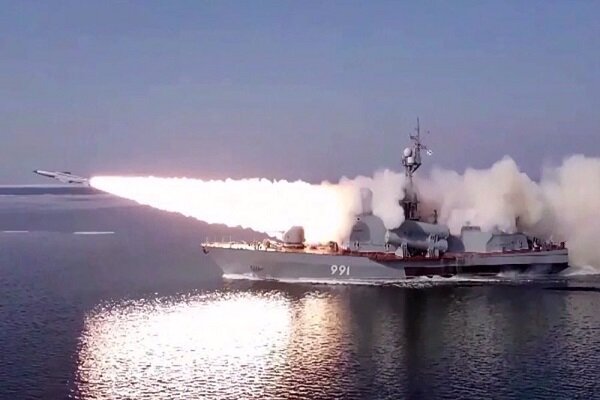

The Russian and Chinese navies have recently carried out joint artillery and anti-submarine drills in the Sea of Japan, according to a statement from the Russian Pacific Fleet on Sunday. These military exercises are part of the scheduled “Maritime Interaction-2025” drills, which are set to conclude on Tuesday.
The maneuvers involve a combined naval detachment, including a large Russian anti-submarine vessel and two Chinese destroyers. Diesel-electric submarines from both countries, as well as a Chinese submarine rescue ship, are also participating in the exercises.
The joint drills include a variety of naval operations such as artillery firing, anti-submarine warfare, air defense training, and joint search and rescue missions.
The exercises are designed to enhance cooperation between the Russian and Chinese navies, allowing them to rehearse coordination in various maritime scenarios and improve their ability to operate together effectively. These exercises send a strategic message of deterrence to other global powers, demonstrating the close military collaboration between Russia and China.
The timing of these drills came just two days after US President Donald Trump announced that he had ordered the deployment of two nuclear submarines to unspecified “appropriate regions.” This move was reportedly in response to statements made by former Russian President Dmitry Medvedev, who issued remarks about the potential risk of war between Russia and the United States.
Despite the timing, Russian officials clarified that the naval exercises with China had been planned well in advance and were not a direct reaction to recent developments involving the United States.
The strategic partnership between Russia and China, often referred to as a “no-limits” partnership, was formalized shortly before Russia’s invasion of Ukraine in 2022. Since then, the two countries have frequently conducted joint military exercises to demonstrate their solidarity and to improve military interoperability.
These actions are seen as part of a broader effort to challenge Western influence and signal to other nations that they remain aligned in their geopolitical objectives.
Trump’s announcement of submarine deployments was unusual, as it is rare for either the United States or Russia to publicly discuss the positioning of their nuclear submarines. The two nations maintain the largest nuclear arsenals globally, and discussions of such deployments typically remain highly confidential.
The announcement came amid increasing tensions between the US and Russia, with Trump expressing frustration over the ongoing conflict in Ukraine and the lack of progress towards a resolution. The situation reflects the heightened state of alert and the complexities of modern nuclear diplomacy amid ongoing geopolitical rivalries.
