

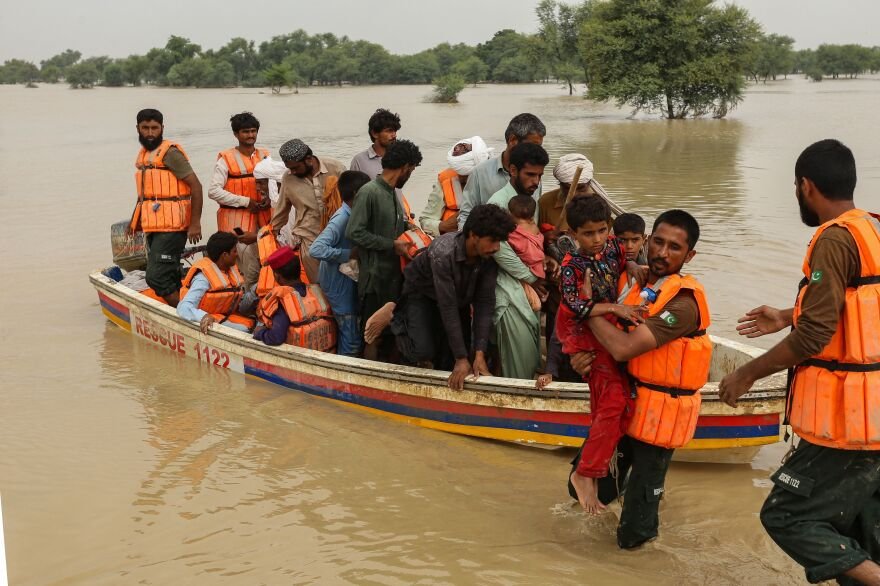

LAHORE: Thousands more residents were forced to flee their homes in flood-hit regions of Taunsa and Layyah on Tuesday, as medium-level flooding in the Indus River (locally referred to as the Sindh river) continues to wreak havoc in southern Punjab. The rising waters have inundated dozens of villages, destroying homes, infrastructure, farmland, and displacing entire communities.
In Taunsa, villages such as Mauza Moor Jhangi, Bait Kachhela, Panj Darain, Bait Channar, Bait Ashraf, Jarh Leghari, and Mouza Baloch Khan were among the worst affected, with residents evacuating to higher ground or temporary shelters.
Similarly, in Layyah district, villages including Mouza Lohaj, Thori, Samra Jhok Khan, Basti Kanjo Mohana, Darkhan Khokhar, Panwar, Alliyani Basti, and Rakhwan were submerged. A newly built two-storey police check post in Rakhwan was completely destroyed by floodwaters, while a high school building in Basti Alliyani was partially submerged, with visible cracks indicating structural damage.
In Karor Lal Esan, the village of Bait Mongar was fully engulfed, leading to the destruction of all homes and the local mosque. Floodwaters also swept across cultivated lands in both Layyah and Karor Lal Esan, turning agricultural fields into temporary riverbeds and devastating crops. In Dera Ghazi Khan, villages like Jhok Utra, Kot Chuta, and Malkani Kalan have also been submerged.
Local anger is growing, particularly over what residents describe as poor planning in the construction of the Layyah-Taunsa Bridge. Residents claim the diversion of the river’s natural flow for the bridge project has redirected floodwaters toward populated areas and fertile lands, worsening the disaster. Protesters accused authorities of failing to manage protective embankments and allowing cracks in riverbanks to go unrepaired for days.
One resident, Khurrum Khar of Layyah, told that out of his family’s 450 acres, only 175 acres remain dry, with the rest consumed by the expanding river. He blamed government mismanagement for the devastation, saying the altered river route has turned previously safe areas into high-risk flood zones. “If this continues, we will lose everything—our land, our homes, our future,” he lamented.
The Punjab Disaster Management Authority (PDMA) has issued flood alerts for multiple regions in anticipation of further heavy monsoon rains. The Pakistan Meteorological Department (PMD) forecasts scattered to widespread thunderstorms with isolated heavy downpours over the upper catchments of the Indus, Jhelum, Chenab, and Ravi rivers. Urban centers such as Islamabad, Peshawar, Rawalpindi, Gujranwala, and Lahore may also experience urban flooding over the next 48 hours.
The Flood Forecasting Division (FFD) reported medium flood levels in the Indus River at Guddu and low flood levels at Tarbela, Kalabagh, Chashma, Taunsa, and Sukkur. Rivers Jhelum and Chenab are also witnessing rising flows, with the potential for moderate flooding in the Ravi’s nullahs and Kabul River’s tributaries. Sutlej River is expected to swell at Ganda Singhwala within the next 24 hours.
PDMA Director General Irfan Ali Kathia emphasized the need for advance preparedness, urging the activation of emergency control rooms and disaster response teams. Relief Commissioner Punjab Nabeel Javed directed local administrations to remain alert and ensure timely evacuations and protective measures.
Authorities have assured affected citizens of full support, including the provision of food, clean water, medical assistance, and temporary shelters at relief camps. Dam levels are also being closely monitored, with Tarbela Dam currently at 87.08% and Mangla at 57.36% of live storage capacity.
Despite these efforts, the scale of displacement and damage continues to rise, highlighting the urgent need for sustainable flood management, better infrastructure planning, and improved early warning systems to mitigate the impact of such recurring natural disasters.
