

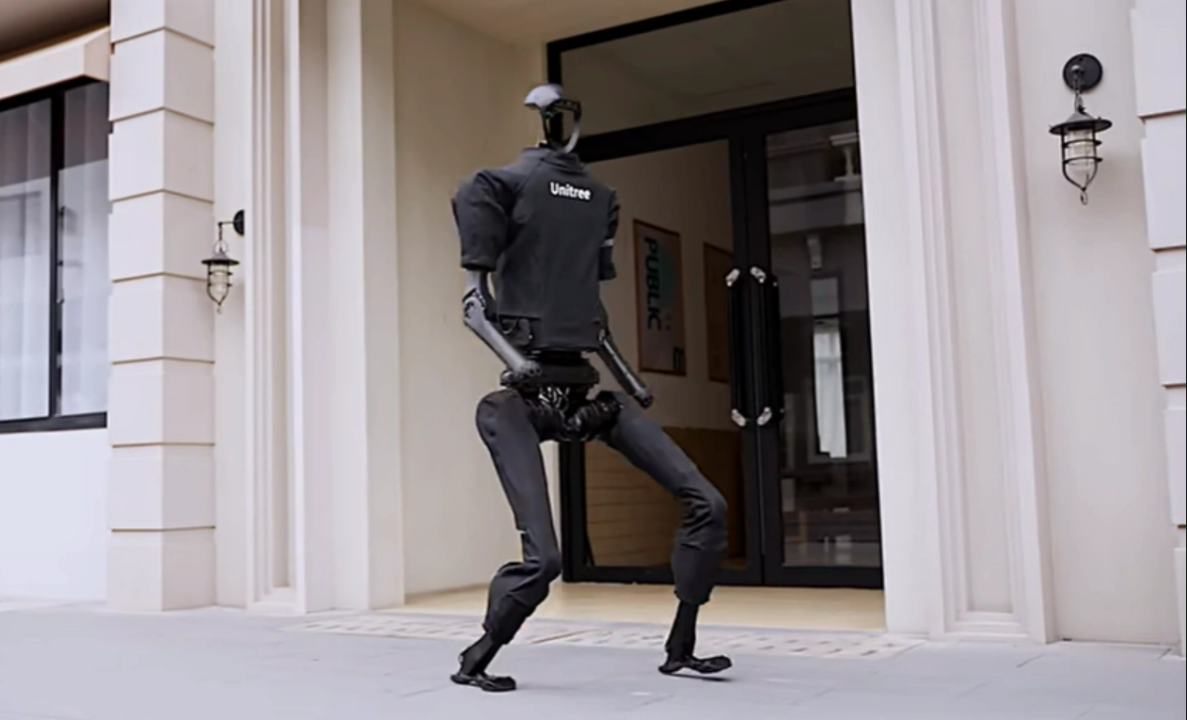

Skild AI, a robotics startup backed by Amazon and Japan’s SoftBank Group, has unveiled a foundational artificial intelligence model aimed at transforming the capabilities of modern robots.
Named Skild Brain, the model is designed to operate across a wide range of robotic platforms—from industrial assembly-line machines to advanced humanoid robots—enabling them to think, move, and react with a level of intelligence and adaptability that mirrors human behavior.
The announcement marks a significant step forward in the broader effort to create general-purpose robots, moving beyond the conventional single-task machines commonly used in factories today.
Demonstration videos released by Skild AI showcased robots using the Skild Brain model climbing stairs, maintaining their balance when pushed, and manipulating objects in messy, unpredictable environments. These tasks require complex spatial reasoning, environmental awareness, and real-time adaptability—traits that have traditionally been challenging to replicate in robotics.
According to the company, Skild Brain incorporates safety mechanisms, including built-in power limits to prevent robots from applying excessive or dangerous force. This is especially critical as robots transition from controlled industrial settings into more dynamic environments where they may interact closely with humans.
Skild’s AI model is trained using a hybrid approach: initially learning through simulated scenarios and human-action videos, and later refined with real-world data collected from every robot using the system.
Co-founders Deepak Pathak and Abhinav Gupta emphasized that unlike language or vision models, robotics lacks vast publicly available datasets online. “You cannot just go and apply these generative AI techniques,” said Pathak, the company’s CEO, in an exclusive interview with Reuters.
Gupta, who previously led Meta Platforms’ robotics lab in Pittsburgh, described Skild Brain as a “shared brain” for robots. As client-deployed robots gather data from various environments, that information is fed back into the model to improve its performance continuously. This feedback loop allows Skild Brain to evolve and adapt rapidly across different industries and use cases.
Skild AI’s clientele already includes notable names like LG CNS—the IT services division of LG Group—and other unnamed partners operating in logistics and industrial sectors.
The company’s approach, according to investor Raviraj Jain of Lightspeed Venture Partners, solves one of robotics’ core scaling challenges: while software can be deployed instantly, physical robotics takes time. Skild’s shared-brain model, however, allows robots to quickly gain new capabilities as they are deployed in the field.
Founded just two years ago, Skild AI has quickly attracted top talent from Tesla, Nvidia, and Meta. In its most recent Series A funding round, the company raised $300 million, securing a valuation of $1.5 billion.
Its roster of investors includes prominent venture firms such as Menlo Ventures, Khosla Ventures, Sequoia Capital, Lightspeed Venture Partners, and Amazon. As Skild Brain enters the market, it sets the stage for a new era in robotics—one driven not just by mechanical design but by artificial intelligence capable of learning, adapting, and collaborating across countless applications.
