

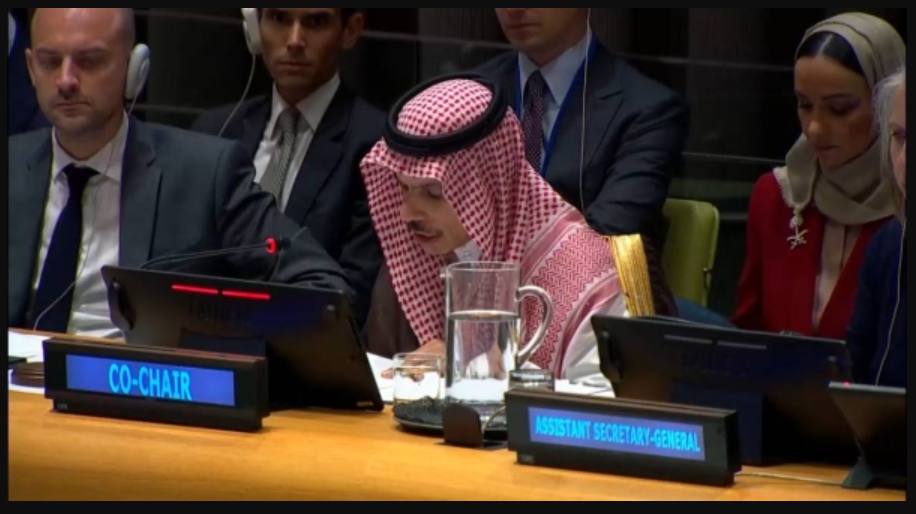

Saudi Arabia and France have jointly hosted a high-level international conference in New York, aiming to revive global momentum for a peaceful resolution to the Israeli-Palestinian conflict through the implementation of a two-state solution. The event, held at the United Nations headquarters, brought together key international stakeholders and was marked by renewed calls for Palestinian statehood and lasting peace in the region.
Saudi Foreign Minister Prince Faisal bin Farhan opened the conference by reaffirming the Kingdom’s unwavering support for the two-state framework, calling it the foundation for enduring peace and regional stability. He described the gathering as a “critical turning point” in efforts to realize a sovereign Palestinian state alongside Israel.
Prince Faisal praised recent developments, including French President Emmanuel Macron’s declaration supporting the recognition of a Palestinian state. He emphasized that granting Palestinians their legitimate rights is essential to ending the conflict. The minister also highlighted the humanitarian crisis in Gaza, announcing a $300 million joint financial commitment by Saudi Arabia and France through the World Bank to support the Palestinian people.
Stressing the importance of collective international action, he reiterated the relevance of the Arab Peace Initiative and called for support of the International Coalition for the Two-State Solution.
French Foreign Minister Jean-Noël Barrot echoed these sentiments, calling for an urgent end to the war and an end to attacks on civilians in Gaza. He emphasized the need to translate the two-state solution from political rhetoric into concrete action, declaring that the conference had generated “unstoppable political momentum” for peace.
UN Secretary-General António Guterres also addressed the forum, lauding the initiative by Saudi Arabia and France. He described the conference as a rare opportunity to accelerate diplomatic efforts and stressed that unilateral actions such as illegal settlements and annexations in the West Bank undermine peace prospects. Guterres reaffirmed the UN’s longstanding support for a two-state solution and encouraged international unity on the issue.
Palestinian Prime Minister Mohammad Mustafa welcomed the conference as a “historic opportunity” and thanked both Saudi Arabia and France for their leadership. He called for internal unity among Palestinian factions and urged Hamas to relinquish its weapons to the Palestinian Authority. To safeguard civilians in Gaza, he proposed the deployment of international peacekeeping forces in coordination with the Palestinian Authority. “We are ready to shoulder our responsibilities. Peace is the only way forward,” he stated.
Despite growing international support for the initiative, the United States declined to participate. State Department spokesperson Tammy Bruce criticized the conference as poorly timed and ineffective, warning it could complicate ongoing diplomatic efforts rather than support them.
Bruce argued that the event was more symbolic than substantive and suggested it might embolden militant groups such as Hamas. She also voiced concern over President Macron’s recognition of a Palestinian state, which has been welcomed by Hamas. “That’s a troubling development,” she said.
The United States reaffirmed its belief that meaningful, behind-the-scenes diplomacy remains the only viable path to resolving the long-standing conflict, cautioning that public forums like the New York conference could do more harm than good at this sensitive juncture.
As global actors continue to navigate the complex landscape of Middle East peace efforts, the Saudi-French initiative signals a renewed push for consensus on the two-state solution. Whether it leads to substantive policy shifts or remains a symbolic gesture depends largely on the response of other key players, particularly those already involved in existing peace processes.
