

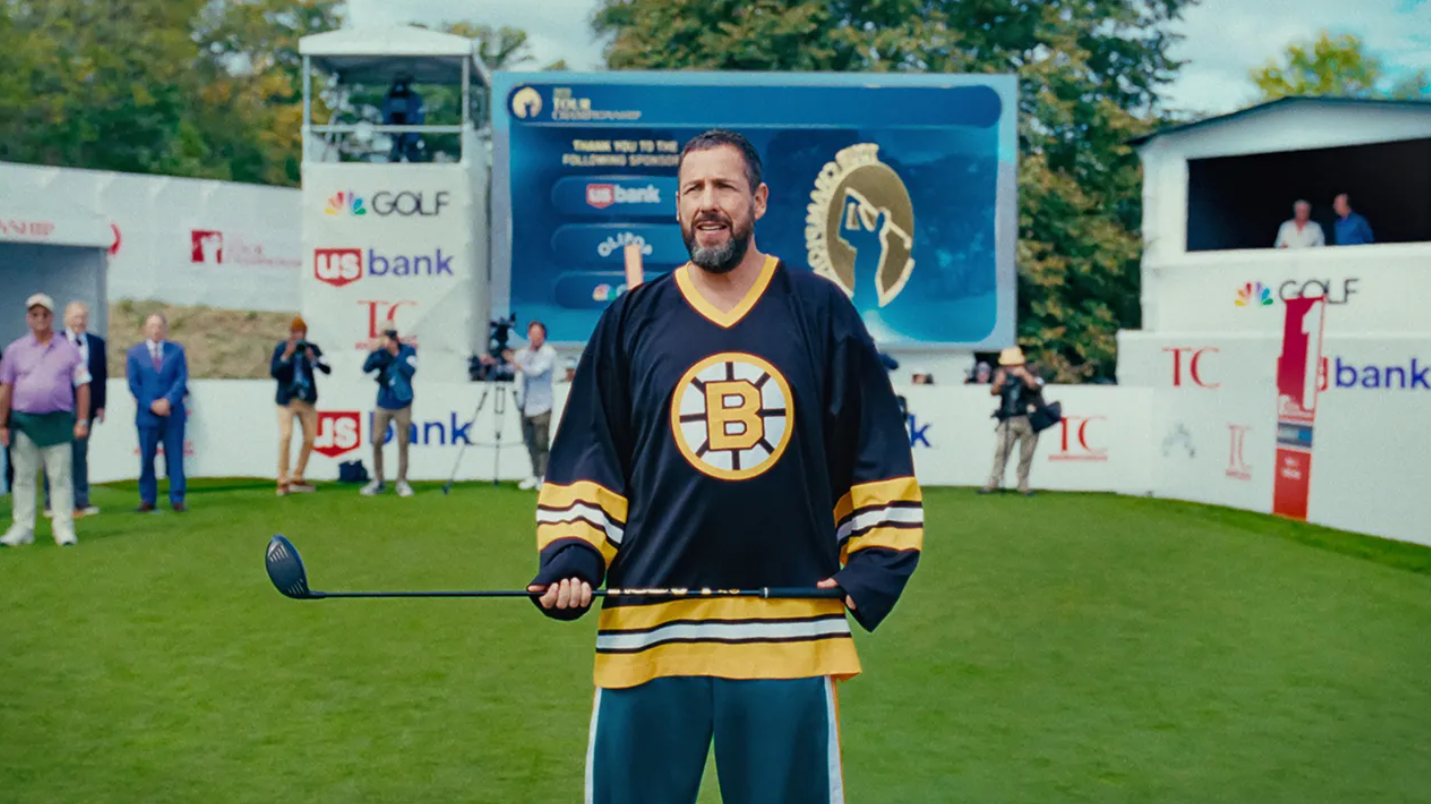

Nearly three decades after its cult-classic predecessor, Happy Gilmore 2 returns with Adam Sandler once again stepping into the spiked shoes of golf’s most unorthodox champion. The sequel, now streaming on Netflix, wastes no time bringing audiences up to speed. We learn Happy’s once-idyllic post-victory life with Virginia (Julie Bowen) includes marriage and five kids. But the joy abruptly ends when a stray tee shot tragically ends Virginia’s life in the film’s opening minutes, a shock that sets the emotional and narrative tone of the sequel.
The story pivots from the original’s lighthearted rescue of Grandma’s house to a more personal, if chaotic, comeback. After Virginia’s death, Happy retires, moving to a run-down triplex with his youngest daughter, Vienna (played by Sandler’s real-life daughter, Sunny Sandler), and descends into alcoholism. He only regains purpose when Vienna’s ballet teacher (Jackie Sandler, Adam’s wife) tells him she has the talent to study in Paris. This dream becomes his new goal—raising enough money through golf to fund her training. But his road back is littered with modern hurdles: a DUI, a disastrous kart crash, and a suspicious energy drink mogul recruiting him for a breakaway golf league clearly spoofing LIV Golf.
While it lacks the freshness and bite of the original 1996 hit, which was itself a sendup of golf elitism, Happy Gilmore 2 still offers plenty for long-time fans. The film leans heavily on nostalgia, with a cameo-laden cast featuring Sandler’s usual collaborators like Rob Schneider, Kevin Nealon, Steve Buscemi, and Jon Lovitz. Christopher McDonald returns as Shooter McGavin, and even the late Carl Weathers’ character, Chubbs, is honored through a creative and hilarious cemetery scene, a cheeky nod to the film’s enduring legacy and its Bob Barker cameo.
Interestingly, the sequel flips the underdog narrative. This time, Happy is a golfing legend rubbing shoulders with icons like Jack Nicklaus, Jordan Spieth, and John Daly, who now lives in Happy’s garage. The shift in tone also emphasizes a newfound reverence for golf tradition, even as Happy remains the wild card of the fairway. The commentary on modern golf – highlighting accessibility, culture clashes, and generational change is a welcome thread, even if it sometimes gets lost amid the chaos.
That chaos includes excessive celebrity cameos (Travis Kelce, Kelsey Plum), an overstuffed final act, and noticeable nepotism, with the entire Sandler family appearing onscreen. Even so, the film’s heart remains intact. Whether it’s the touching father-daughter subplot or the welcome absurdity of Bad Bunny as a caddie named Oscar, there are enough sincere and silly moments to keep fans engaged.
For viewers unfamiliar with the original or indifferent to golf, Happy Gilmore 2 may fall flat. But for the loyal fanbase who’ve quoted lines like “must be Burt Reynolds” for decades, this sequel delivers a warm, if uneven, return. It’s a nostalgic love letter to simpler times, where slapstick humor and heart could share the same screen without apology.
