

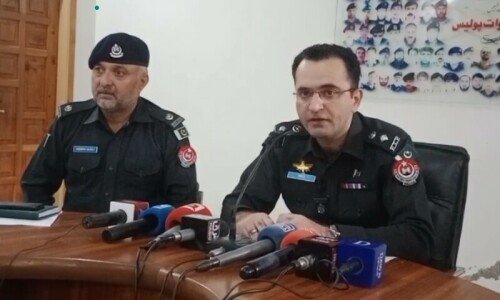

Authorities in Swat have sealed a madressah in Chaliyar village after a tragic incident in which a young student was allegedly beaten to death by his teachers. The disturbing event occurred on Monday evening, prompting swift police action. According to District Police Officer (DPO) Muhammad Omar, the student was rushed to a nearby hospital by fellow students and teachers but was declared dead upon arrival.
Addressing a press conference alongside Superintendent of Police (Investigation) Badshah Hazrat Khan, DPO Omar revealed that police conducted immediate inquiries with other students at the seminary. Their statements exposed additional cases of violence against other children at the institution. As a result, police detained all madressah staff, arrested two suspects named in the First Information Report (FIR), and launched a search to apprehend the remaining two. The FIR was registered under the Khyber Pakhtunkhwa Child Protection Act, with investigations ongoing into potential sexual abuse. Relevant sections will be added to the FIR if such allegations are confirmed.
DPO Omar confirmed that approximately 160–170 students were safely returned to their families. Items allegedly used in the assault have been recovered by police as evidence.
Calls for Accountability and Systemic Reforms Amid Ongoing Abuse Reports
In response to the incident, KP’s Chief Khateeb Maulana Tayyab Qureshi issued a strong condemnation. He described the student’s death as “the height of brutality” and called for exemplary punishment for the perpetrators. Qureshi emphasized that Islam does not condone violence against children and warned against enrolling children in unregistered seminaries. He applauded the authorities’ immediate actions, including sealing the institution and returning the children to their families.
The incident has reignited concerns over corporal punishment in religious and private educational institutions in Khyber Pakhtunkhwa. Despite being illegal under the KP Child Protection and Welfare Act 2010 and its 2018 regulations, such abuse continues. The law prescribes up to six months in prison or a Rs50,000 fine for violations. Still, recent reports reveal persistent mistreatment, including 14 recorded incidents of corporal punishment among 33 types of abuse against children across the province.
Earlier this year, the KP Private Schools Regulatory Authority issued strict warnings against corporal punishment. Yet, enforcement remains weak. In one such case from April, a teacher in Kasur was arrested for using a hot iron on a student who failed to memorize a lesson.
Qureshi urged religious scholars to monitor seminaries and ensure children are protected from violence, stating that such mistreatment severely harms students’ mental and physical health and tarnishes the reputation of religious institutions.
