

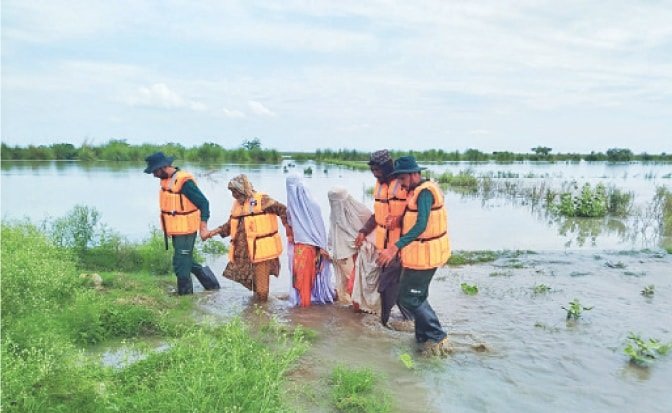

ISLAMABAD: The Pothohar region was also among the worst-hit areas by the torrential rains which swept across the Punjab province on Thursday, triggering widespread flooding and prompting rescue operations by Pakistan Army personnel. More than 1,000 people were evacuated to safety, officials confirmed.
A rain emergency has been declared in Chakwal, Jhelum, and Rawalpindi, where the downpour caused rivers and drains to overflow, stranding residents in several low-lying areas. Helicopters were deployed as part of the emergency response to access areas cut off by floodwaters.
According to a spokesperson for the Provincial Disaster Management Authority (PDMA), about 398 people were rescued in Jhelum alone, with 160 airlifted to safety. In Chakwal, 209 individuals were evacuated — 182 by local authorities and 27 via helicopter.
In Rawalpindi, the district administration moved 450 people to secure locations. Notably, six people trapped in Nala Lai were rescued by helicopter in a high-risk operation.
PDMA Director General Irfan Ali Kathia praised the coordinated efforts, stating that no casualties had been reported due to the timely response. He urged citizens to remain alert, noting that above-normal rainfall is expected this monsoon season, with the fourth wave of rains beginning July 21.
Kathia advised the public to take precautionary measures and stay in safe areas, assuring that all available resources will be mobilized to protect lives and property during the ongoing monsoon.
Several killed in Punjab province
Several people were killed in the last 24 hours in Punjab province amid devastating rains. At least 54 people have died in the past 24 hours across Punjab due to monsoon havoc, bringing Pakistan’s total monsoon death toll to 178.
The monsoon havoc has severely disrupted life in Rawalpindi and Islamabad, triggering flash floods, overflowing drains, and inundating entire neighbourhoods.
In Rawalpindi, hours of continuous rain caused Nullah Lai to swell dangerously, with floodwaters sweeping away vehicles and submerging low-lying areas. Authorities issued evacuation alerts for residents in Katarian and Gawalmandi as a precautionary measure.
The Rawalpindi administration declared Thursday a public holiday to keep residents indoors, while the Pakistan Meteorological Department warned of continued heavy rain through Friday.
Islamabad also bore the brunt of the storm. Several homes experienced basement flooding, and landslides were reported near the Bari Imam shrine area.
Emergency Declared After 450mm Rainfall
A rain emergency has been declared in several districts including Rawalpindi, Chakwal, and Islamabad. The Meteorological Department reported intense rainfall, with Chakwal receiving 450mm in a short period. The extreme weather led to the collapse of a small dam at Dherabi, unleashing floodwaters into nearby villages.
Roads and bridges in affected rural areas have been damaged or washed away, leaving dozens of communities isolated. The historic Katas Raj temple complex was also flooded.
Authorities remain on high alert as forecasts predict further rainfall into the night.
NDMA issues another alert
Meanwhile, the National Disaster Management Authority (NDMA) has issued an alert for heavy rainfall across multiple regions of the country in the next 24 hours. NDMA cautioned people against the risks of urban flooding and overflowing rivers and streams.
According to an NDMA spokesperson, strong winds, thunderstorms, and heavy downpours are expected over the next 12 hours in Lahore, Chakwal, Attock, Jhelum, and Khushab. Similar weather conditions are forecast for Sargodha, Gujrat, Gujranwala, and Faisalabad, while heavy rains are also likely in Sialkot, Narowal, Okara, Kasur, Sheikhupura, and Hafizabad.
In Islamabad and Rawalpindi, intermittent heavy rainfall is projected to persist for the next 24 to 48 hours, increasing the threat of flash floods and waterlogging in low-lying areas.
The NDMA emphasized that preventive measures are being implemented in coordination with provincial and local authorities. Citizens have been urged to exercise extreme caution, avoid crossing flooded roads, bridges, and fast-flowing streams, and follow official advisories to ensure their safety.
