

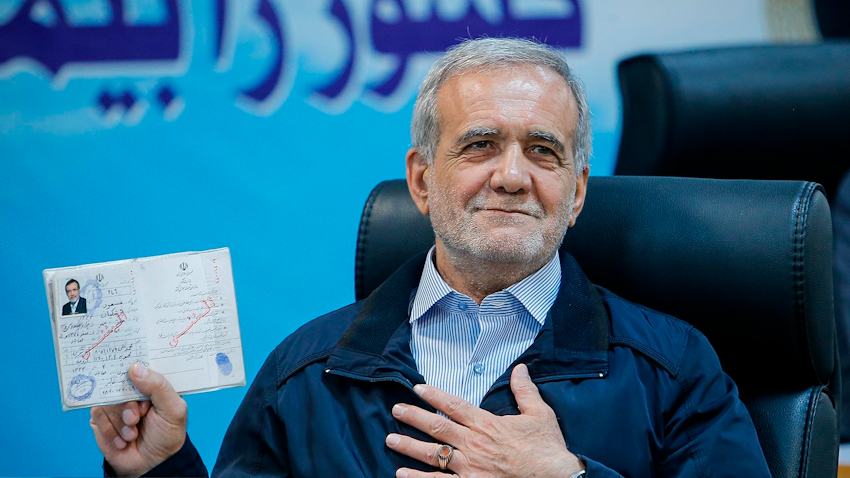

Iranian President Masoud Pezeshkian was compelled to finish a portion of his recent journey to Tabriz by taxi after all three of his official vehicles, including those used by his security team, broke down due to contaminated fuel, according to a senior government official.
Mostafa Moulavi, the president’s special inspector, revealed that the incident occurred near Takestan in Qazvin province, shortly after the presidential convoy refueled at a gas station near the Rasht exit. “Our investigation showed the station was distributing low-quality fuel mixed with water. This wasn’t the first offense — it has a record of similar violations,” Moulavi said during a visit to Qazvin’s provincial offices, as reported by Iran International.
Instead of contacting local officials for help, President Pezeshkian reportedly chose to hire a private taxi and continued his journey without alerting the provincial governor or requesting assistance. “He did not seek any official support,” Moulavi noted.
The National Iranian Oil Products Distribution Company (NIOPDC) later confirmed that the gas station in question had been the subject of previous complaints about fuel quality. However, authorities did not provide a reason for why it remained in operation.
Neither the president’s office nor the Ministry of Petroleum has commented publicly on the incident.
Persistent Fuel Quality Issues in Iran
Fuel contamination continues to be a widespread problem in Iran, with drivers frequently reporting issues such as watered-down gasoline and manipulated fuel pump meters. Social media has been flooded with videos exposing these practices, though energy authorities consistently deny systemic problems in fuel distribution.
Rains unleashed widespread devastation
The ongoing monsoon rains have unleashed widespread devastation across Pakistan, resulting in at least 105 fatalities and over 211 injuries between June 26 and July 13, according to the National Disaster Management Authority (NDMA).
The casualties include 49 children, 38 men, and 18 women, with one additional death reported in Khanewal in the past 24 hours. Among the injured are 81 men, 82 children, and 48 women, highlighting the human toll of the unrelenting weather.
Beyond the tragic loss of life, the floods have wreaked havoc on infrastructure and homes. The NDMA reported damage to more than 10 kilometers of roads and nine bridges. Flash floods and heavy rainfall have completely destroyed 145 houses and partially damaged 310 others.
Punjab Bears the Brunt of rains; Lahore Reports Most Deaths
Punjab has emerged as the most severely affected province. The Provincial Disaster Management Authority (PDMA) confirmed 44 deaths and 134 injuries so far this monsoon season. Rain-related incidents have also impacted 50 homes and led to the deaths of six livestock.
According to PDMA data, 27 people were killed in building collapses, five lost their lives due to lightning strikes, four were electrocuted, and eight drowned while bathing in rain-fed streams or floodwaters.
In the last 24 hours alone, four more people lost their lives—two in Okara and two in Bahawalnagar—while 25 others sustained injuries in rain-related incidents.
Emergency Response and Public Advisory
PDMA Director General Imran Qureshi confirmed that emergency medical services are being provided to the injured and urged the public to take all necessary precautions.
“Children must be kept away from electric wires, poles, and waterlogged areas. Citizens are strongly advised to remain vigilant during the ongoing monsoon spell,” he said.
