

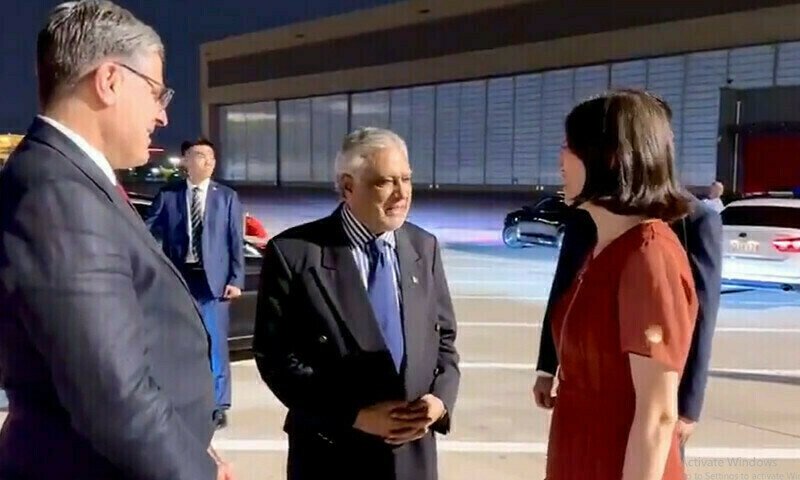

BEIJING: Deputy Prime Minister and Foreign Minister Ishaq Dar arrived in Beijing on Monday for an official visit to China, the Foreign Office confirmed.
Upon arrival, he was welcomed at the airport by Yu Hong, Director-General for Asian Affairs at China’s Ministry of Foreign Affairs. Pakistan’s Ambassador to China, Khalil-ur-Rahman Hashmi, along with senior Chinese officials, was also present to receive him.
Dar will represent Pakistan at the Shanghai Cooperation Organisation (SCO) Council of Foreign Ministers’ meeting scheduled to be held in Tianjin on Tuesday.
According to Foreign Office spokesperson Mumtaz Zahra Baloch, the Deputy Prime Minister will hold bilateral meetings with foreign ministers of various SCO member countries and is expected to attend a joint meeting with Chinese President Xi Jinping, alongside other SCO foreign ministers.
SCO Member Nations and their Objectives
The Shanghai Cooperation Organisation (SCO) is a permanent intergovernmental international body comprising nine member states: India, Iran, Kazakhstan, China, Kyrgyzstan, Pakistan, Russia, Tajikistan, and Uzbekistan.
The organisation aims to foster mutual trust and good neighbourly relations among its members while promoting cooperation across a wide range of areas, including politics, trade, economy, science and technology, culture, education, energy, transportation, tourism, and environmental protection.
The SCO also works collectively to uphold regional peace, security, and stability and strives for the development of a democratic, fair, and balanced international political and economic order.
Key Advantages of SCO Membership for Member Nations:
- Regional Security and Stability
- Joint efforts in combating terrorism, extremism, separatism, and organized crime.
- Enhanced cooperation in intelligence sharing and border security.
- Economic and Trade Cooperation
- Access to a larger regional market of over 3 billion people.
- Promotion of trade, investment, and economic collaboration among members.
- Infrastructure development initiatives like roads, railways, and energy corridors.
- Energy and Resource Sharing
- Collaboration on energy projects, including oil, gas, and renewables.
- Efficient use and management of regional natural resources.
- Connectivity and Transport Integration
- Development of transport and logistics networks to improve regional connectivity.
- Support for initiatives like China’s Belt and Road Initiative (BRI).
- Cultural and Educational Exchange
- Promotion of cultural understanding and people-to-people contact.
- Student exchange programs, academic collaboration, and joint research.
- Multilateral Diplomacy Platform
- A strategic platform for dialogue and diplomacy among regional powers.
- Opportunity to resolve bilateral issues within a multilateral framework.
- Environmental Cooperation
- Joint strategies to address climate change, environmental protection, and disaster management.
- Balanced Global Order Advocacy
- Collective voice in advocating for a more multipolar and equitable global political and economic system.
These advantages make SCO membership highly valuable for enhancing regional cooperation, security, and socio-economic development.
