

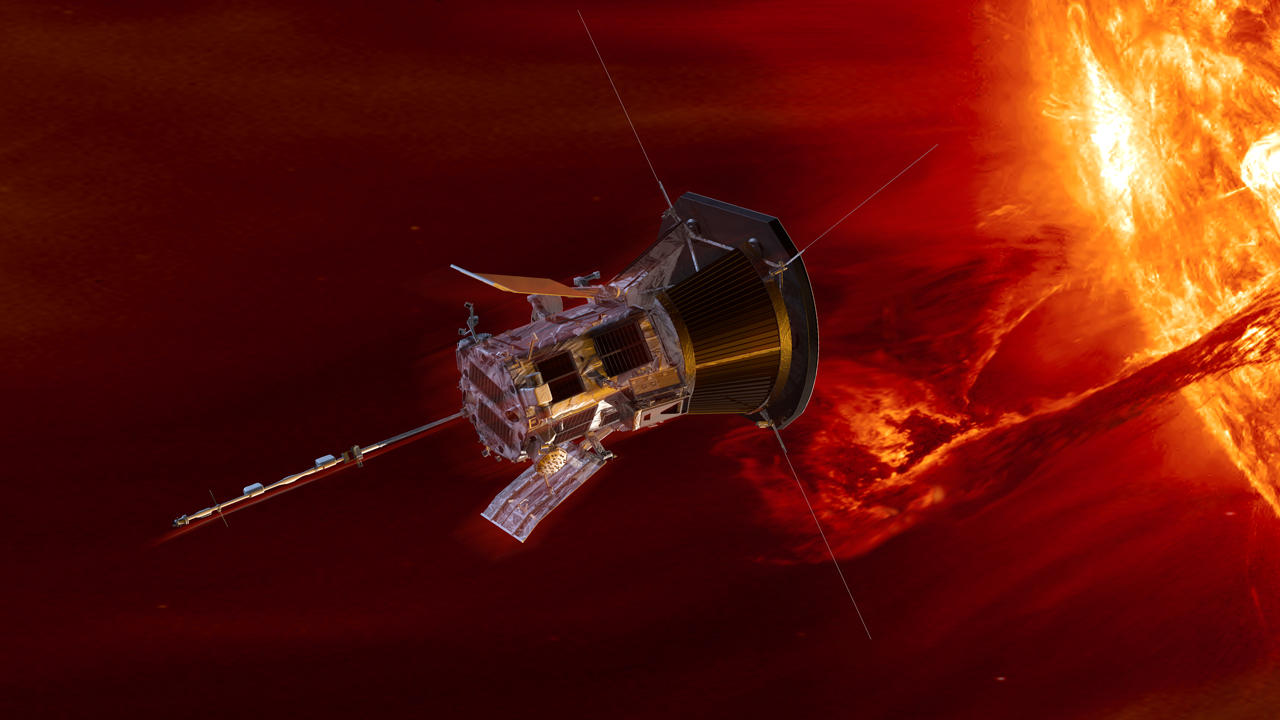

NASA’s Parker Solar Probe has captured the most detailed images ever taken of the Sun, from an astonishing distance of just 3.8 million miles (6.1 million kilometers). These images are shedding new light on the origins of the solar wind and its effects on Earth.
Taken during a close flyby on December 24, 2024, the striking photos offer scientists clearer insights into the solar wind, a steady stream of charged particles flowing from the Sun’s outer atmosphere, known as the corona.
This flow not only creates dazzling auroras but can also trigger powerful space weather events capable of disrupting satellite operations and power infrastructure on Earth.
One of the probe’s key contributions is helping to address a persistent puzzle about the slower solar wind, which is denser and less predictable than the faster-moving streams.
“For years, the big question has been how the solar wind forms and manages to escape the Sun’s immense gravitational force,” explained Nour Rawafi, the Parker Solar Probe’s project scientist at the Johns Hopkins Applied Physics Laboratory.
Thanks to its latest pass, the probe has confirmed an important theory: the slow solar wind is made up of two distinct types—Alfvénic and non-Alfvénic. The images suggest that Alfvénic winds might originate from cooler regions called coronal holes, whereas non-Alfvénic winds likely come from hotter magnetic structures known as helmet streamers.
“We’re still piecing the story together, but the fresh data is incredibly promising,” noted Adam Szabo, mission scientist for the Parker Solar Probe at NASA’s Goddard Space Flight Center.
Launched in 2018, the Parker Solar Probe is the first spacecraft to venture into the Sun’s corona. Equipped with advanced tools like the Wide Field Imager for Solar Probe (WISPR), the probe is built to withstand extreme heat and radiation to deliver groundbreaking data.
The mission continues, with the probe’s next closest approach to the Sun, known as perihelion, set for September 15.
