

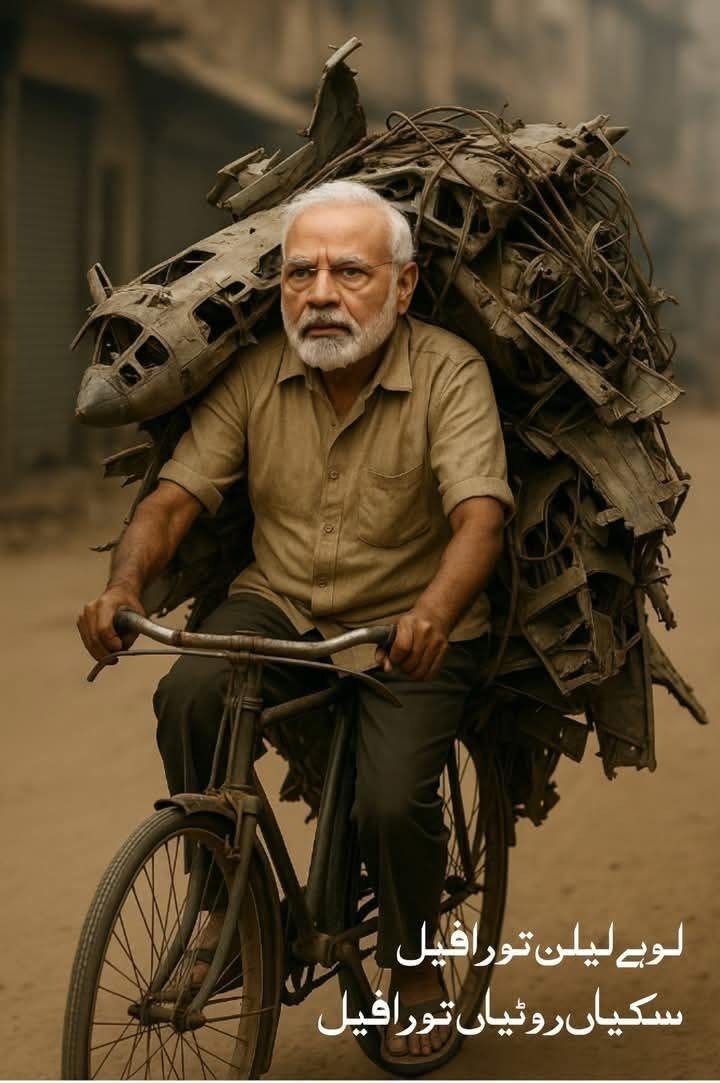

ISLAMABAD: Deputy Prime Minister and Foreign Minister Ishaq Dar has unveiled key details of Pakistan’s military and diplomatic response to recent escalations with India, asserting that the country has destroyed four Indian Rafales and effectively countered misinformation and disproven claims of diplomatic isolation.
Speaking at a press briefing, Dar said that following the Pulwama (Pahalgam) incident, Pakistan had offered a free and transparent investigation, “because our hands were clean,” yet received no response from India.
“Despite narratives suggesting Pakistan’s diplomatic isolation, we were elected to the UN Security Council with 170 votes—during a time of economic sanctions,” he noted, emphasizing the international community’s continued support.
Dar underscored the strength of Pakistan’s defensive capabilities, calling them a “protective shield” for the nation. He further revealed that during heightened tensions, from April 22 to May 6, Pakistan reached out to 29 world capitals to counter India’s disinformation, reiterating that Pakistan had no role in the Pahalgam incident and reminding global leaders that the country remains one of terrorism’s biggest victims.
Referring to military provocations, Dar said, “On the night of May 6, India deployed 75 to 80 jets. We were prepared. Our orders were clear—do not engage unless they violate our airspace. But if attacked, we would respond decisively.” He claimed that Pakistan shot down six Indian aircraft, including four Rafale jets, a Sukhoi-30, and a MiG, a response he said India struggled to digest.
He alleged further Indian escalations, including missile launches targeting Amritsar and attacks on Pakistani airbases. “From 4 a.m. to nearly 8 a.m. on May 9, we delivered a clear and firm response,” Dar stated.
Dar recalled that shortly after the escalation, international diplomatic efforts intensified. “While in my office, I received a call from U.S. official Rubio, asking if we were open to a ceasefire. After consulting with the army chief and prime minister, we agreed. Within 45 minutes, the Saudi foreign minister confirmed the ceasefire agreement from our side.”
However, he criticized India’s continued provocations even after the ceasefire, accusing New Delhi of attempting to save face with additional missile activity and redeployment of troops. “Their military repositioned, but their political leadership continues to deny the reality,” he remarked.
Rejecting India’s ambitions of regional dominance, Dar said, “They wanted to act as the regional hegemon and peace provider, but we shattered that illusion. Pakistan is no longer isolated—in fact, the challenge now is choosing which diplomatic invitations to accept.”
He emphasized Pakistan’s commitment to equality and mutual respect, regardless of a country’s size. On regional peace, he added, “Peace and stability in Afghanistan are crucial for us too.” He highlighted that Pakistan has resumed senior-level engagement with Kabul after a four-year gap, including his own visit on April 19 aimed at rebuilding trust.
