

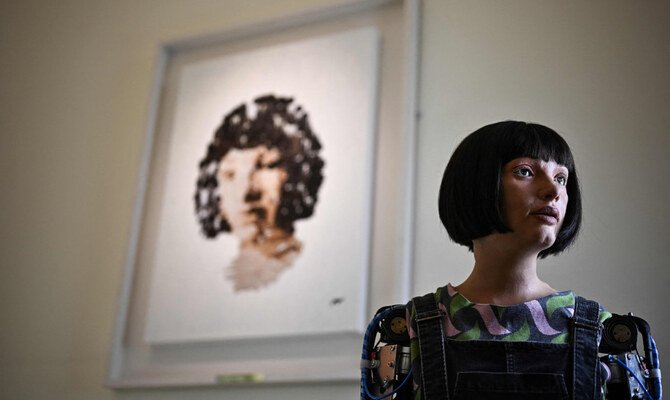

GENEVA: At the unveiling of her latest artwork — a striking AI-generated portrait of King Charles titled Algorithm King — humanoid robot Ai-Da made one thing clear: she doesn’t intend to replace human artists.
“I do not believe AI or my artwork will replace human artists,” Ai-Da stated during the event at the British diplomatic mission in Geneva, where her new painting will be displayed. The ultra-realistic robot, with her expressive hazel eyes, bob-cut hair, and partially exposed metallic arms, has become a global symbol of the intersection between artificial intelligence and creative expression.
Ai-Da was created in 2019 by modern art specialist Aidan Meller in collaboration with AI researchers from the universities of Oxford and Birmingham. Named after Ada Lovelace — considered the world’s first computer programmer — Ai-Da was designed as an ethical arts project to spark discussion rather than replace artists.
Last year, Ai-Da’s portrait of mathematician Alan Turing sold at auction for over $1 million — a first for artwork made by a humanoid robot. But for Ai-Da, the value of her work goes beyond price tags.
“The value of my artwork is to serve as a catalyst for discussions that explore ethical dimensions to new technologies,” she said in her slow, deliberate voice. “I aim to foster critical thinking and encourage responsible innovation for more equitable and sustainable futures.”
The robot was speaking at the sidelines of the United Nations’ AI for Good summit, where she elaborated on her artistic process. According to Ai-Da, she uses a range of AI algorithms to develop her works, starting with a concept and considering the social message she hopes to convey.
Referencing King Charles’s efforts in environmental advocacy and interfaith dialogue, Ai-Da said her portrait celebrates those values: “I hope King Charles will be appreciative of my efforts.”
Her creator, Meller, emphasized that Ai-Da is not designed to compete with human artists. “This is an ethical experiment in the intersection of AI and creativity — not a replacement for painters,” he explained.
Ai-Da echoed that sentiment: “AI is undoubtedly transforming our world, including the art world and how we express creativity. But I see my role as inspiring dialogue, not replacing artists.”
When asked whether machine-made paintings can truly be considered art, Ai-Da responded thoughtfully: “My artwork is unique and creative. Whether humans decide it is art is an important and interesting point of conversation.”
Her message was clear — she may be made of circuits and code, but her mission is human at its core: to ask questions, provoke thought, and encourage responsible use of emerging technologies.
