

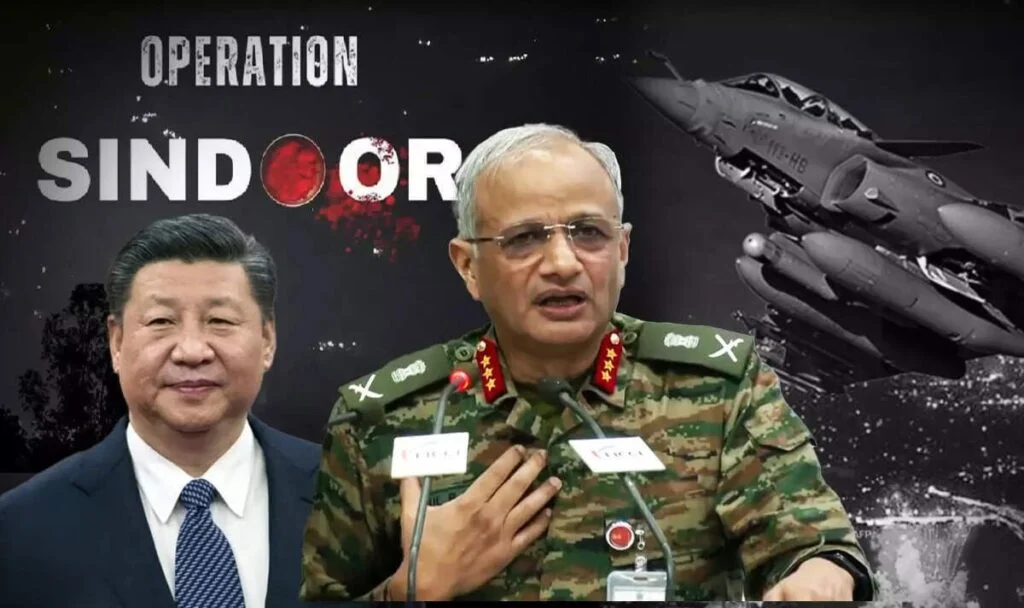

Operation Sindoor
India’s senior military leadership is currently under intense scrutiny following the failure of Operation Sindoor, with senior commanders offering conflicting accounts regarding China’s role in assisting Pakistan. This discord has raised significant questions about India’s strategic clarity and overall defense preparedness in managing complex regional conflicts.
At a recent event hosted by the Observer Research Foundation in Delhi, Chief of Defence Staff General Anil Chauhan provided a measured assessment of China’s involvement. He stated that there is no concrete evidence proving that Pakistan received real-time targeting assistance or direct military support from China during the operation.
General Chauhan described Beijing’s backing as ambiguous and difficult to clearly define, emphasizing that no direct proof has yet emerged to establish active collaboration between China and Pakistan in the context of Operation Sindoor.
Contrasting sharply with this viewpoint, Deputy Army Chief Lieutenant General Rahul R Singh presented a different narrative. He asserted that China had indeed provided Pakistan with live intelligence on Indian troop movements, which enabled Islamabad to closely monitor India’s preparations along key fronts during the 87-hour standoff.
Lt Gen Singh described the conflict as involving “three adversaries,” highlighting how China’s intelligence support gave Pakistan a significant advantage by enhancing their situational awareness in real time, despite official military-to-military communication channels between India and China remaining open.
General Chauhan countered this assertion by suggesting that any intelligence Pakistan may have accessed was more likely derived from commercial Chinese satellite imagery rather than through direct military cooperation with Beijing.
He underscored that while Pakistan sources the majority of its weaponry from China, this fact alone does not equate to Beijing’s direct involvement in operational planning or combat support during the confrontation.
These divergent accounts from two of India’s top military officials have triggered widespread debate and criticism of the country’s defense leadership. Analysts argue that instead of presenting a cohesive and unified assessment of the operation’s shortcomings, the conflicting narratives reflect deeper divisions within India’s military establishment.
This fragmentation appears to undermine credibility and suggests that some officials may be deflecting responsibility by shifting blame towards China and Pakistan for India’s tactical and strategic failures during Operation Sindoor.
The ongoing disagreement also raises broader concerns about India’s ability to effectively coordinate its defense strategy amidst complex geopolitical challenges, particularly when facing adversaries that operate in concert or receive external support.
The differing military perspectives underscore the urgent need for greater transparency and cohesion in India’s defense discourse to restore public confidence and strengthen the country’s strategic posture moving forward.
