


‘Live Inputs’
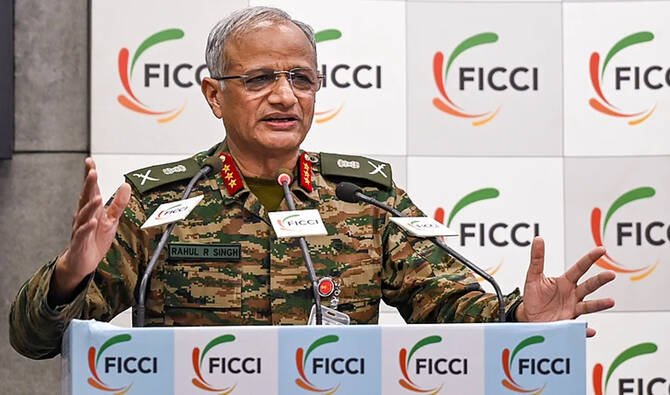
In a rare and candid admission, Indian Army Deputy Chief Lt. Gen. Rahul Singh acknowledged Pakistan’s military superiority during the recent four-day conflict between the nuclear-armed neighbors — a battle now referred to as Marka-e-Haq.
The skirmish, which erupted after a deadly April attack on tourists in Indian-administered Kashmir, marked the most intense India-Pakistan confrontation in decades. While New Delhi blamed Islamabad for the attack, Pakistan strongly denied any involvement. Both sides later agreed to a ceasefire following high-level military talks.
During a defense industry event in New Delhi, Lt. Gen. Singh revealed that Pakistan gained a critical strategic advantage during the conflict through its advanced use of electronic warfare capabilities, which left Indian forces both stunned and confused.
He said Pakistan demonstrated superior battlefield coordination and seemed to possess precise knowledge of Indian troop movements and deployments, a fact that disrupted Indian operational planning.
“It became evident during the conflict that Pakistan was aware of the status of our key defense systems,” Singh admitted. “They knew which vectors were primed and ready. This level of insight was alarming.”
Crucially, Singh claimed that Pakistan was receiving real-time intelligence or “live inputs” from China, significantly boosting its situational awareness. He said that during director general of military operations (DGMO) level talks, Pakistani officials made specific references to Indian military positions that had been activated, suggesting they had access to up-to-the-minute battlefield data, possibly shared by Chinese surveillance or intelligence systems.
“Pakistan was the front face,” Singh said, “but China provided all possible support behind the scenes.”
Although he did not detail how India confirmed China’s live support, Singh stressed the urgent need for India to upgrade its air defense systems, which underperformed during the clash. The incident, he warned, underscores the growing threat of a coordinated two-front challenge from both Pakistan and China, with potential future involvement from Turkiye as well.
Singh also revealed that Turkiye supplied Bayraktar drones and other unmanned aerial systems to Pakistan during the battle, along with trained personnel. Turkish backing, he added, further strengthened Pakistan’s aerial advantage. Turkiye’s support for Islamabad during the conflict sparked anger across India, leading to social media campaigns boycotting Turkish products and tourism.
This marks a significant shift in India’s official narrative. Previously, Indian officials, including the Chief of Defence Staff, had downplayed the notion of active Chinese assistance, stating that any satellite imagery could be commercially available and not necessarily indicative of state-level cooperation.
Meanwhile, Pakistani officials have repeatedly rejected claims of Beijing’s direct military support but have not categorically denied receiving satellite or radar data from China. The strategic implications of this remain profound, particularly as regional alliances appear to be shifting.
Lt. Gen. Singh’s remarks have ignited a fresh debate in Indian defense circles about the need to modernize intelligence-gathering capabilities, close technological gaps, and prepare for multi-front warfare in an increasingly complex geopolitical environment.
