



The Vera C. Rubin Observatory in Chile has unveiled its first official images, capturing breathtaking views of the cosmos, including vibrant star-forming regions and distant galaxy clusters.
After more than two decades of development, the US-funded observatory stands atop Cerro Pachón in central Chile—an ideal location for astronomy due to its high altitude, dark skies, and dry atmosphere.
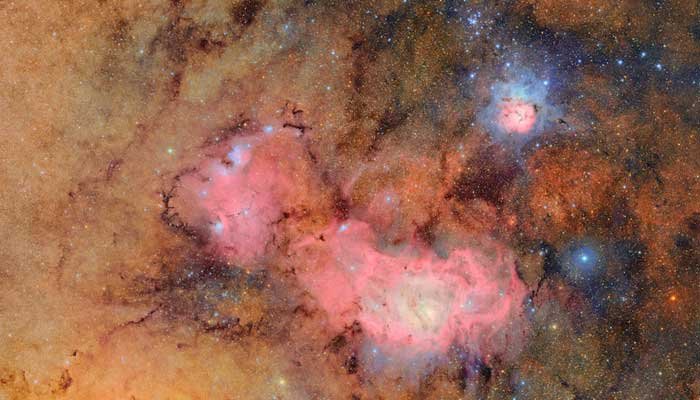
Among the initial images released on Monday is a striking composite made from 678 exposures taken over just seven hours. It showcases the Trifid and Lagoon Nebulae, thousands of light-years from Earth, glowing in vivid pink and orange-red hues. These nebulae—stellar nurseries within the Milky Way—appear with unprecedented clarity, revealing structures that were once too faint to observe.
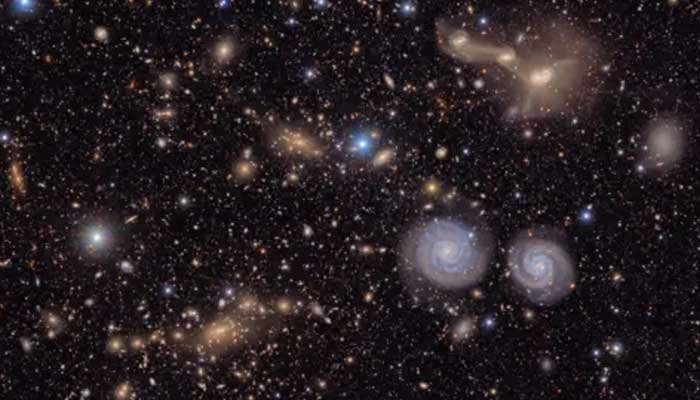
Another image offers an expansive look at the Virgo Cluster, a massive collection of galaxies. A video titled the “Cosmic Treasure Chest” was also released, beginning with a close-up of two galaxies and zooming out to unveil nearly 10 million more.
“The Rubin Observatory is an investment in our future. It lays the groundwork of knowledge today for future generations to build upon,” said Michael Kratsios, head of the White House Office of Science and Technology Policy.
The observatory is equipped with an 8.4-meter telescope and the largest digital camera ever constructed, supported by a powerful data processing infrastructure. Later this year, it will officially begin its Legacy Survey of Space and Time (LSST), a 10-year mission to scan the night sky each evening, detecting even the slightest changes with extraordinary precision.
Named in honor of astronomer Vera C. Rubin, whose groundbreaking work confirmed the existence of dark matter, the observatory is poised to become one of the most advanced instruments for space exploration. Dark matter and dark energy—mysterious forces believed to comprise 95% of the universe—remain largely unknown, and Rubin’s data will help unlock their secrets.
The observatory is also expected to revolutionize asteroid tracking. In just ten hours of observation, it detected 2,104 previously unknown asteroids, including seven near-Earth objects, none of which pose a threat. For perspective, all other observatories combined discover roughly 20,000 new asteroids annually.
Rubin is also expected to be the most capable ground-based telescope for detecting interstellar objects entering our solar system.
More images from the observatory are set to be released later in the day.
