

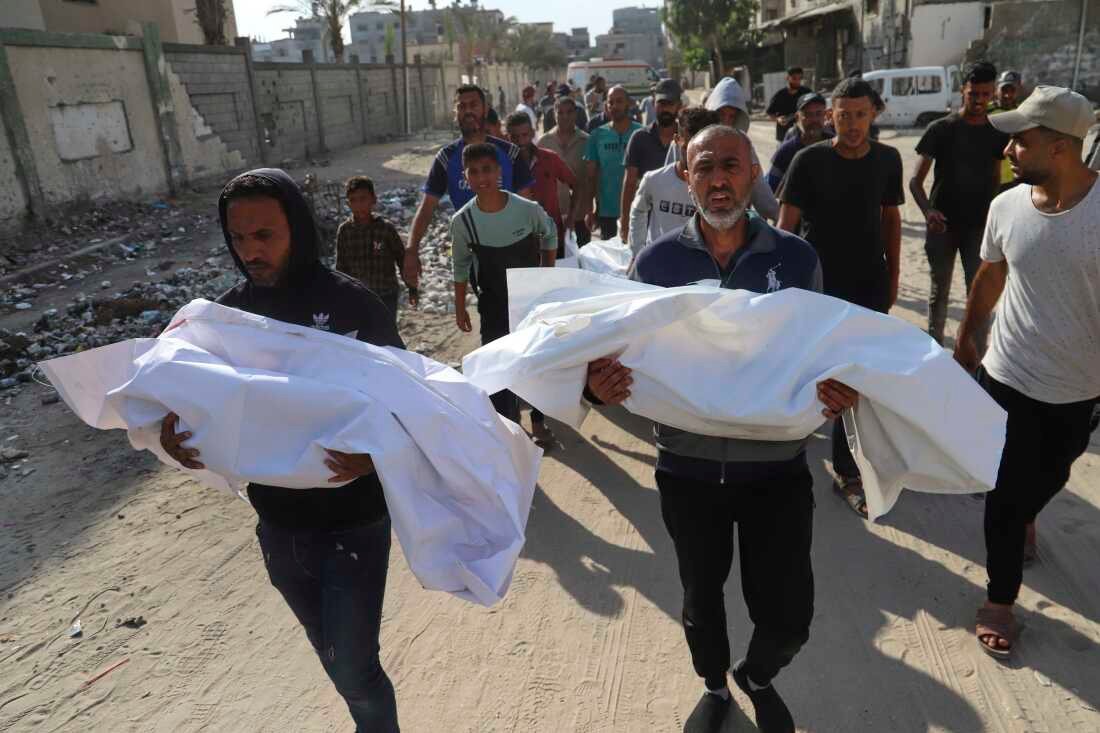

At least 82 Palestinians were killed in a wave of Israeli air and ground assaults across the Gaza Strip, including dozens of civilians who had gathered near humanitarian aid distribution points in central and southern Gaza, health officials reported on Friday.
According to Gaza’s Health Ministry, 34 of those killed were seeking food and water aid—many of them women and children—near sites operated by the Gaza Humanitarian Foundation (GHF), an organization backed by Israel and the United States but criticized by several international groups.
The deadliest of the reported incidents occurred in central Gaza, where Israeli forces allegedly opened fire on civilians waiting for food assistance. Medical sources told that 23 people were killed in that attack alone. Eleven more were killed in similar strikes in the south.
Elsewhere, Israeli airstrikes targeted a residential building west of Deir el-Balah, resulting in multiple casualties. In Gaza City, 23 people were reported killed as bombardments intensified throughout the day.
The Gaza Government Media Office said that the total number of Palestinians killed while seeking humanitarian aid has now risen to 409, with more than 3,200 wounded since GHF began operations on May 27.
International humanitarian organizations and UN agencies have condemned the repeated attacks on civilians at food and water distribution points. UNICEF spokesperson James Elder described the situation as “catastrophic,” warning of a looming public health disaster as clean water and food supplies dwindle.
“Just 40 percent of Gaza’s drinking water infrastructure remains functional,” Elder said during a press briefing in Geneva. “Children will begin to die of thirst.”
He also cited eyewitness accounts of children and mothers being injured while attempting to access aid, and warned of widespread confusion and chaos at GHF distribution sites. Unannounced openings, communication blackouts, and the proximity of some aid sites to active combat zones have reportedly contributed to the rising toll.
“There have been tragic cases where families rushed to what they believed was an open aid site, only to come under fire,” Elder noted.
Despite the growing criticism, GHF claims it has distributed over three million meals across three sites “without incident.” However, UN officials challenged that claim on Friday, arguing that GHF’s presence has exacerbated an already dire humanitarian situation, especially in the context of Israel’s blockade of Gaza that severely restricted the entry of food, water, and medical supplies from March through late May.
Meanwhile, broader regional tensions continue to escalate. Israel and Iran exchanged fire over the past week, prompting sharp rebukes from global leaders. Turkish President Recep Tayyip Erdoğan condemned Israel’s campaign in Gaza, warning that the conflict is “rapidly approaching a point of no return.”
“This madness must end now,” Erdoğan said at a youth forum organized by the Organisation of Islamic Cooperation (OIC) in Istanbul.
He also accused Israel of hypocrisy for condemning Iranian strikes on Israeli hospitals, pointing out that Israeli forces had “carried out over 700 attacks on medical facilities in Gaza alone.”
As the war enters its ninth month, pressure continues to mount on Israel to allow unfettered humanitarian access and to halt military operations that have increasingly targeted civilian areas.
According to Gaza’s health authorities, more than 37,000 Palestinians have been killed since the conflict began—most of them women and children—and over 1.9 million have been displaced.
