

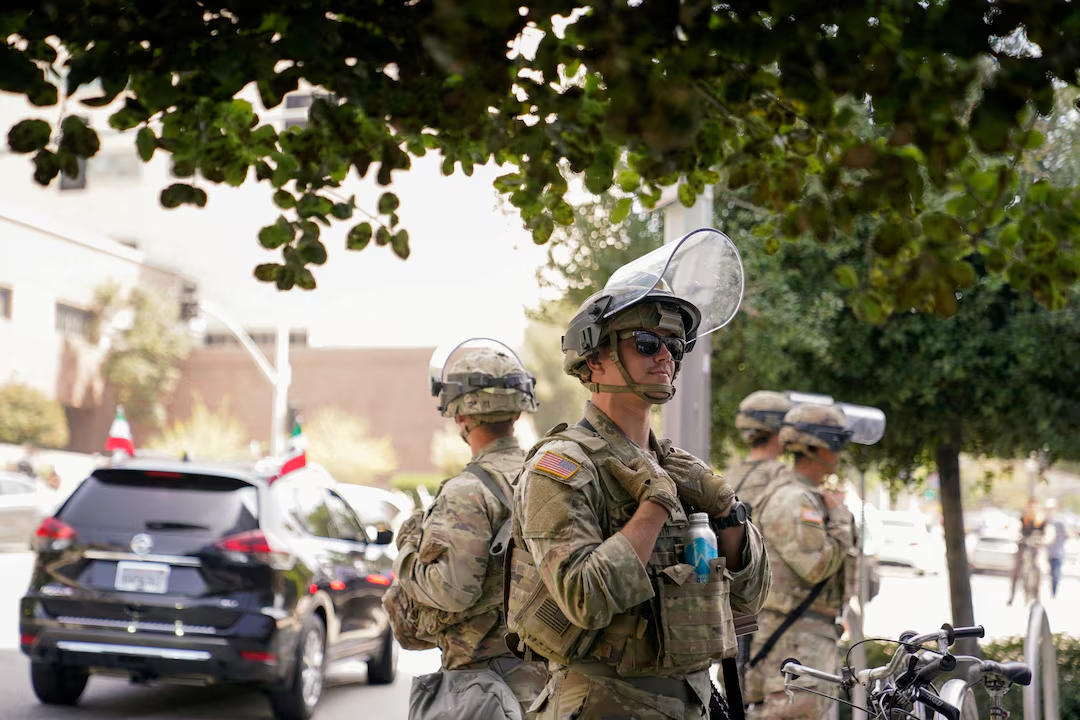

California National Guard
A U.S. appeals court ruled on Thursday that President Donald Trump may continue to exercise control over California’s National Guard while the state’s Democratic Governor, Gavin Newsom, proceeds with a legal challenge against the controversial deployment of troops to quell protests in Los Angeles.
The case stems from Trump’s June 7 directive to federalize California’s National Guard and send 4,000 troops into Los Angeles in response to unrest surrounding his administration’s immigration enforcement operations.
Trump also ordered 700 U.S. Marines into the city, despite objections from Governor Newsom. The president’s actions sparked a national debate on the legality and appropriateness of deploying military forces within U.S. cities.
U.S. District Judge Charles Breyer ruled on June 12 that Trump had unlawfully called the National Guard into federal service by failing to properly coordinate with the state government. Breyer concluded that the conditions required under federal law to justify such federalization—such as an invasion, rebellion, or inability to enforce U.S. laws—were not present. He ordered Trump to return control of the Guard to Governor Newsom.
However, a three-judge panel of the San Francisco-based 9th U.S. Circuit Court of Appeals temporarily blocked Breyer’s ruling and, on Thursday, extended that stay.
The panel said that Trump likely acted within his constitutional authority, noting that his administration had probably fulfilled the coordination requirement with Newsom. Furthermore, even if coordination was lacking, the court said Newsom did not possess the power to veto the president’s directive.
“We hold that the president likely has authority to federalize the National Guard,” the court stated in its opinion. However, the panel noted that the decision did not address what specific roles the federalized Guard may undertake, leaving room for future legal challenges.
The judges added that Newsom could still challenge the use of the National Guard and Marines under different laws, including those restricting military involvement in domestic law enforcement. These arguments are expected to be raised in an upcoming hearing before Judge Breyer.
In response to the ruling, Governor Newsom vowed to continue his legal fight. “The president is not a king and is not above the law,” he posted on X. “We will press forward with our challenge to President Trump’s authoritarian use of U.S. military soldiers against our citizens.”
Trump celebrated the court’s decision on Truth Social, calling it a victory for public safety. “This is a great decision for our country, and we will continue to protect and defend law-abiding Americans,” he wrote. “This is much bigger than Gavin, because all over the United States, if our cities and our people need protection, we are the ones to give it to them should state and local police be unable to get the job done.”
The Justice Department had argued that once a president determines an emergency exists, his decision to deploy the National Guard cannot be challenged by courts or state governments. The 9th Circuit rejected this sweeping claim of executive immunity, asserting that judicial review remains a check on presidential power.
The three-judge panel included two Trump-appointed judges and one appointed by President Joe Biden, underscoring the bipartisan nature of the court’s deliberation. The case continues to highlight the tense balance between federal authority and state sovereignty, especially in times of civil unrest.
