


North Korea
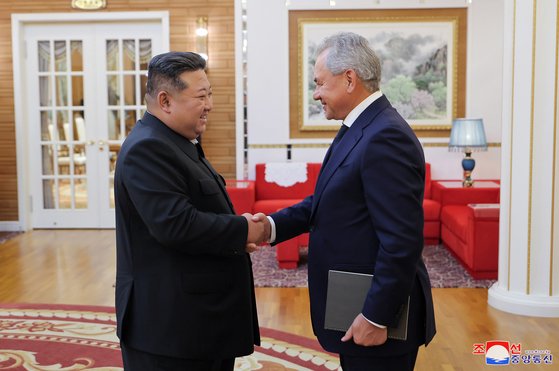
North Korea has announced it will dispatch thousands of military personnel to Russia’s war-affected Kursk region to assist in post-conflict reconstruction and mine-clearing operations. This development was reported by state media on Tuesday, following a high-profile visit by Russian Security Council chief Sergei Shoigu to Pyongyang, where he held extensive talks with North Korean leader Kim Jong Un.
According to Shoigu, Pyongyang has committed to sending 1,000 military sappers to clear land mines in the southwestern Russian region of Kursk, which has seen heavy fighting due to Ukrainian military incursions.
Additionally, 5,000 North Korean military construction workers will be deployed to help rebuild critical infrastructure destroyed during the conflict. Shoigu referred to Ukrainian forces as the “occupiers” and emphasized the necessity of foreign support to rehabilitate the damaged region.
Shoigu also noted that Russia and North Korea have agreed to jointly commemorate Korean soldiers who reportedly died during operations in support of Russia. Plans are underway to establish a memorial complex and museum in Pyongyang, which will be constructed with active participation from the Russian side. This initiative is part of a broader diplomatic and military cooperation agenda that has intensified in recent months.
North Korea’s latest gesture of support reflects its increasingly close alliance with Moscow since the launch of Russia’s full-scale invasion of Ukraine in 2022.
The country has already been accused of sending arms to Russia, and late last year reportedly dispatched troops to assist in repelling Ukrainian forces from Russian territory. These claims, while controversial, underscore a deepening strategic partnership between the two historically isolated powers.
Shoigu’s trip was described by Russian state media as a “special assignment” from President Vladimir Putin, aimed at advancing bilateral military and political cooperation.
During the visit, both sides reaffirmed their commitment to implementing the strategic partnership agreement signed last year, which includes a mutual defense clause. The pact obliges both nations to respond jointly in the event of an external threat.
Footage aired by state broadcasters showed Shoigu receiving a warm welcome in Pyongyang, where he embraced Kim Jong Un before the two leaders held closed-door discussions.
This marked the third time Shoigu has visited North Korea in recent months. He emphasized that the “rapid implementation” of the strategic partnership agreement requires constant oversight and real-time coordination, highlighting how significant this alliance has become to both nations.
The growing Russia–North Korea axis has sparked international concern, especially given its implications for global security and the broader balance of power in Asia and Eastern Europe.
