

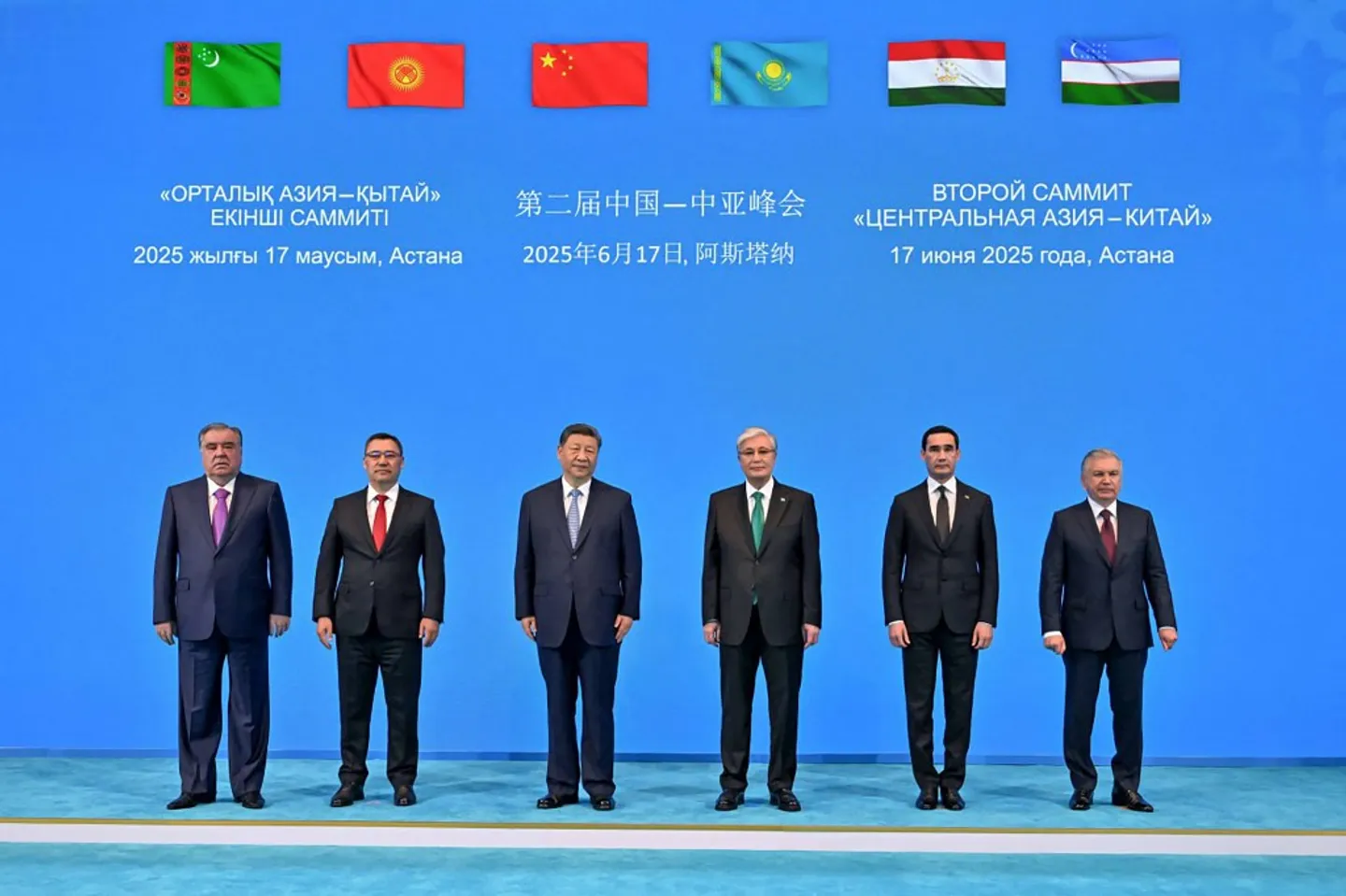

Chinese President Xi Jinping and the leaders of five Central Asian countries signed a landmark treaty pledging “eternal friendship” and cooperation during a regional summit held on Tuesday in Astana, Kazakhstan.
The “Treaty on Eternal Good Neighbourliness, Friendship and Cooperation” was signed by the heads of state from China, Kazakhstan, Kyrgyzstan, Uzbekistan, Tajikistan, and Turkmenistan, according to a statement from Kazakh President Kassym-Jomart Tokayev’s office.
The summit, aimed at deepening diplomatic and economic ties, came as China continues to expand its influence in Central Asia—an area once firmly within Russia’s sphere of influence but now a strategic focal point for multiple global powers.
In his address, Xi criticized U.S. trade policies, reaffirming Beijing’s opposition to protectionism. “Tariff wars and trade wars have no winners,” he said, in remarks carried by China’s state news agency Xinhua. His comments came as Western leaders gathered for the G7 summit in Canada.
Xi also urged stronger cooperation with the region, emphasizing practical collaboration across infrastructure, energy, and emerging technologies. In talks with Kyrgyz President Sadyr Japarov, Xi called for progress on the China-Kyrgyzstan-Uzbekistan railway project and joint ventures in clean energy, green minerals, and artificial intelligence.
Central Asia’s location—at the crossroads of China, Russia, Europe, and the Middle East—makes it a critical hub for logistics and trade. Since gaining independence after the Soviet Union’s collapse in 1991, the five Central Asian nations have increasingly balanced relations among Russia, China, the European Union, and the United States.
While Moscow remains an important strategic partner, its influence in the region has waned following the war in Ukraine. In contrast, China’s Belt and Road Initiative has funneled substantial investments into the region’s infrastructure, giving Beijing additional economic and diplomatic leverage.
The summit underscores a broader shift, as Central Asian states position themselves as a unified bloc to attract foreign investment and political engagement. Alongside regular meetings with China and Russia, the group has also pursued high-level “5+1” talks with Western nations including the EU, the U.S., and Türkiye.
