

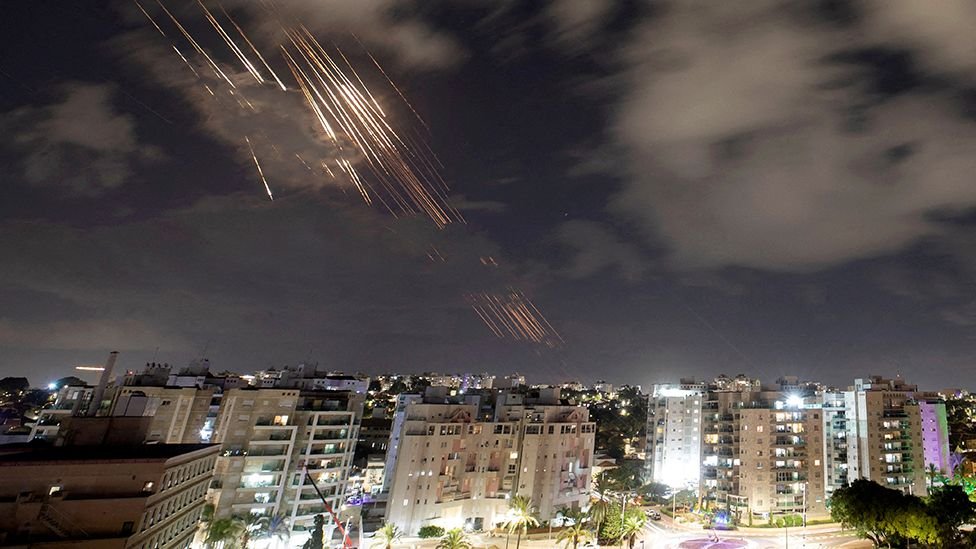

Massive Retaliatory Strike
The Israeli military has confirmed that Iran has launched a large-scale retaliatory attack against Israel, involving over 100 hypersonic missiles along with 10 ballistic missiles.
This development represents a significant escalation in the already tense situation between the two countries, following a series of recent Israeli airstrikes targeting Iranian sites. Israeli defense forces are currently engaged in assessing the damage caused by the missile barrage and exploring possible response options to the attack.
According to reports from Israeli media, multiple Iranian missiles struck the city of Tel Aviv, sparking widespread alarm among the population and triggering immediate emergency response measures.
Smoke was seen rising from various parts of Tel Aviv, while explosions were also heard in both Tel Aviv and Jerusalem, reflecting the gravity and scale of the assault. This missile strike marks the most serious escalation so far in the ongoing confrontation, which has seen repeated airstrikes and retaliatory actions over the past week.
An Israeli Defense Forces (IDF) spokesperson confirmed that the attack is still ongoing, with dozens of additional missiles launched toward Israel after the initial wave. The IDF continues to monitor the situation closely as it unfolds, and authorities are working swiftly to manage the immediate consequences of the strikes.
Regarding casualties, CNN reported that while Iranian missiles did fall on a community within the Tel Aviv district, there have been no injuries reported so far, according to Israeli police.
However, property damage has occurred. Police and bomb disposal teams are actively working to isolate the missile impact sites to prevent further risks and to ensure public safety.
It is important to understand the difference between hypersonic and ballistic missiles, as both were used in this attack. Hypersonic missiles travel at speeds exceeding Mach 5 — which is five times the speed of sound — and have the ability to maneuver mid-flight.
This maneuverability makes them extremely difficult to intercept with conventional missile defense systems. Ballistic missiles, by contrast, typically follow a high-arching trajectory and, while they can reach hypersonic speeds during their reentry phase, have limited ability to change course once launched.
The use of hypersonic missiles in this attack signals a new level of technological sophistication and strategic challenge in the ongoing conflict between Iran and Israel.
The situation remains volatile, and Israeli authorities continue to assess the full impact of the missile strikes as the region braces for further developments.
