

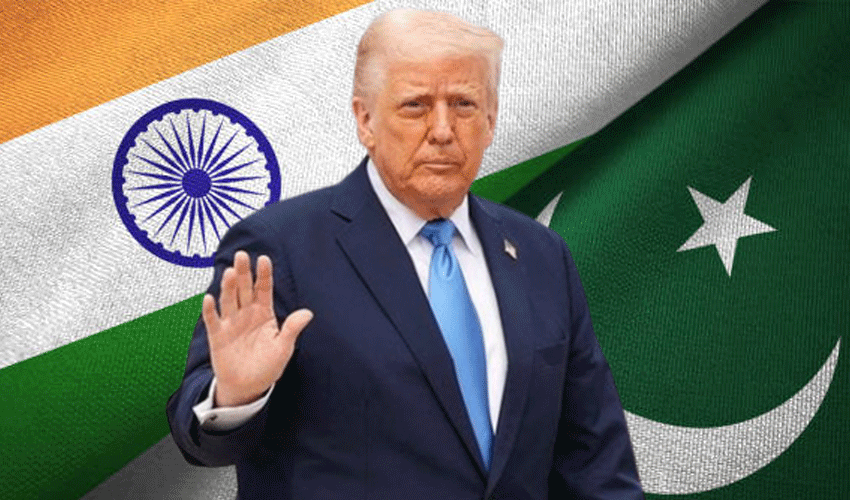

Pakistan’s recent diplomatic outreach appears to be yielding results, as the US State Department has expressed hope that President Donald Trump may help facilitate a resolution to the longstanding Kashmir conflict during his tenure.
This development follows a formal inquiry by this correspondent regarding a recent meeting between Under Secretary of State for Political Affairs Allison Hooker and a Pakistani parliamentary delegation led by Pakistan Peoples Party (PPP) Chairman Bilawal Bhutto Zardari. Questions were specifically directed at whether the US had signaled a willingness to use its influence to bring India to the negotiating table to address core issues and maintain the fragile ceasefire.
Responding to the inquiry, State Department spokesperson Tammy Bruce confirmed that Under Secretary Hooker had met with the Pakistani delegation during their visit to Washington. “She reiterated US support for the ongoing ceasefire between Pakistan and India,” Bruce said, adding that the discussions also covered key aspects of the bilateral relationship, including counterterrorism cooperation.
Bilawal led a nine-member delegation on a weeklong visit to New York and Washington from May 31 to June 6. During the trip, he engaged with over a dozen members of the US Congress and held high-level meetings with State Department officials, presenting Pakistan’s stance on issues such as Indian aggression, the stalling of the Indus Waters Treaty, and inflammatory rhetoric from the Modi government. Coincidentally, an Indian parliamentary delegation was also in Washington at the same time.
Bruce noted that Deputy Secretary Landau met separately with the Indian delegation and reaffirmed US support for India’s counterterrorism efforts and the strategic partnership between the two countries.
The backdrop to these engagements includes heightened regional tensions and international concern following Pakistan’s military retaliation to Indian actions — an episode widely seen as diplomatically costly for India. In response, global powers, including the US, moved to defuse tensions and support the ceasefire agreement.
Taking ownership of these efforts, President Trump offered to mediate between India and Pakistan to resolve all outstanding issues, most notably the Kashmir dispute. On his social media platform, Truth Social, Trump posted:
“I will work with you, both to see if, after a ‘thousand years,’ a solution can be arrived at concerning Kashmir.”
Pakistan welcomed the offer, while India rejected it, sticking to its long-standing position that Kashmir remains a bilateral issue, not open to third-party mediation.
When asked whether President Trump might pursue concrete steps — such as convening both prime ministers or backing a UN Security Council initiative — Bruce declined to comment on his future plans. However, she emphasized the President’s proactive role in conflict resolution.
“He has a history of bringing people to the table who otherwise wouldn’t talk. It’s not surprising that he’d want to be involved in resolving something as protracted as Kashmir,” she said.
While the ceasefire agreement initially raised hopes for meaningful dialogue, there has been little public progress, and both sides remain quiet about potential next steps.
Bruce concluded on a hopeful note:
“I can’t speak to specific plans, but we know the President’s nature — he takes initiative where others hesitate. This could be a pivotal moment. Let’s thank not only God but also Secretary Rubio, President Trump, and the Vice President. Every day brings new opportunities, and perhaps this conflict, too, can move toward resolution before his term ends.”
Diplomatic observers suggest that the upcoming United Nations General Assembly session in New York this September could offer a rare opportunity for a breakthrough — possibly even a meeting between the leaders of India and Pakistan, with President Trump playing a mediating role.
