

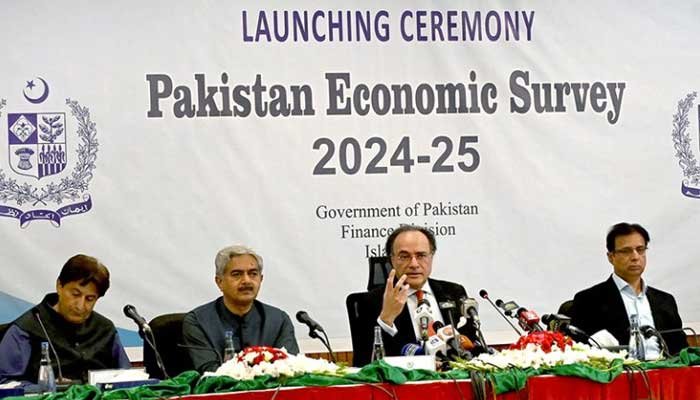

ISLAMABAD: The Economic Survey 2024–25, released just ahead of Pakistan’s federal budget, presents a picture of cautious optimism as the country shows signs of economic stabilization while remaining vulnerable under the $7 billion IMF program.
The budget for the upcoming fiscal year, beginning in July, will be unveiled on Tuesday (today/June 10). Here’s a breakdown of the key findings, as analysed by Arif Habib Limited:
Economic Performance
- GDP Growth: The economy expanded by 2.68% in FY25, with GDP at current prices rising 9.1% to Rs114.7 trillion. Per capita income increased 9.7% to $1,824.
- Inflation: Headline inflation fell sharply—0.3% in April 2025 compared to 17.3% a year earlier. Average inflation from July to April stood at 4.7%, down from 26%.
- Investment & Savings: The investment-to-GDP ratio improved to 13.8%, while the savings-to-GDP ratio rose to 14.1%.
Sectoral Highlights
- Agriculture: Grew by just 0.56%, with livestock expanding 4.72%. Major crops declined 13.49%, impacted by reduced cultivation and adverse weather.
- Industry: Registered 4.77% growth, supported by small-scale manufacturing. Large-scale manufacturing shrank 1.5%, hampered by high costs and supply issues.
- Services: Expanded 2.91%, remaining the dominant sector with a 58.4% share in GDP. Growth was driven by retail, transport, and public services.
Fiscal and Monetary Developments
- Fiscal Position: Pakistan recorded its first quarterly fiscal surplus in 24 years (Rs1,896 billion, or 1.7% of GDP in 1QFY25). The full-year fiscal deficit narrowed to 2.6%, and the primary surplus reached 3.0%.
- Interest Rates: The policy rate was reduced to 11% in May 2025 from a peak of 22%, reflecting eased inflation and lower energy/food prices.
- Money & Credit: Broad Money (M2) grew 4.5%, while private sector credit surged to Rs767.6 billion. Consumer financing rebounded, increasing Rs71.4 billion.
External Sector
- Stock Market: The KSE-100 index soared 50.2%, closing at 117,807 points in March 2025, buoyed by macro stability and IMF progress.
- Current Account: Posted a $1.9 billion surplus, reversing a $1.3 billion deficit last year. Forex reserves rose to $16.64 billion.
- Remittances: Hit a record high of $4.1 billion in March, totaling $31.2 billion (up 31% YoY) from July to April FY25.
Debt & Financial Innovation
- Public Debt: Stood at Rs76 trillion by March 2025 (domestic: Rs51.5 trillion; external: Rs24.5 trillion or $87 billion).
- Debt Management: The government retired Rs2.4 trillion in short-term T-bills and introduced new instruments like a 2-year zero-coupon PIB and 1-month T-bill. Strategic buybacks totaled Rs1 trillion.
- Green Finance: Pakistan launched its first Green Sukuk worth Rs30 billion and secured $1.4 billion under the IMF’s RSF for climate resilience.
Outlook
- Growth Projections: Real GDP is projected to reach potential in FY26, with medium-term growth estimated at 5.7%, backed by macro stability and reforms under the URAAN Pakistan strategy.
- Inflation Outlook: Expected to remain between 5–7%, supported by global disinflation and domestic food security.
- Current Account: Forecasted to stay manageable at 0.8% of GDP, driven by export growth, controlled imports, and strong remittances.
- Policy Focus: Export diversification, regional trade ties, and fiscal consolidation through tax reforms and privatisation are key priorities.
- Risks: Slower global trade, tighter immigration policies abroad, and return migration pose challenges to exports and remittance inflows, necessitating stronger domestic job creation and labour absorption.
