

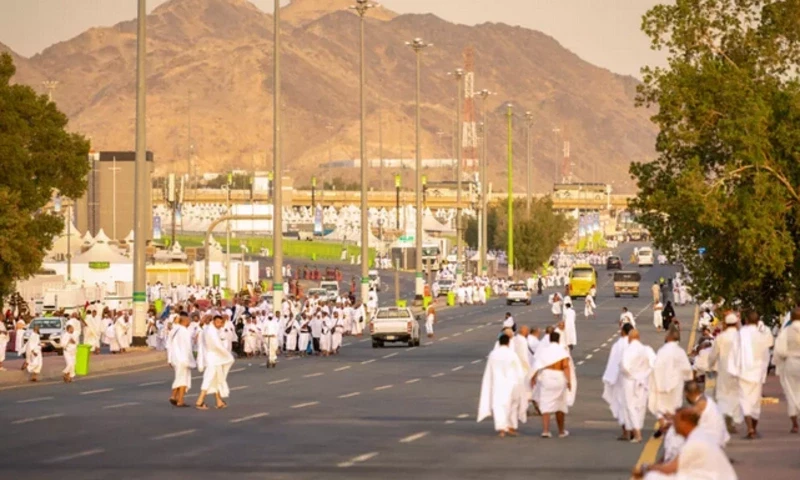

Thousands of Muslim pilgrims gathered on Mount Arafat on Thursday, marking the most sacred and spiritually significant day of the annual Hajj pilgrimage. As the faithful prayed and recited verses from the Quran, Saudi officials urged participants to avoid the outdoors during the peak heat hours due to dangerously high temperatures.
In the early hours before dawn, pilgrims began assembling around the mount—also known as Jabal al-Rahma—and the surrounding plain, the historic site where Prophet Muhammad is believed to have delivered his final sermon. While many arrived early to benefit from the relatively cooler morning temperatures, the majority remained throughout the day, engaging in prayer and reflection until sunset in what is widely considered the most physically and spiritually demanding part of the pilgrimage.
Following sunset, the pilgrims are set to travel to Muzdalifah, located between Arafat and Mina, where they will collect pebbles to perform the symbolic “stoning of the devil” ritual in the coming days.
“This is something I grew up watching on TV every year during Hajj, and I always dreamed of being here,” said Ali, a 33-year-old pilgrim from Pakistan. “I’ve been trying to come for the past three years. I feel incredibly blessed.”
Dressed in simple white garments symbolizing purity and unity, pilgrims crowded the slopes of the mount and the plain below—many praying, some taking photographs to mark the moment.
Due to the extreme heat—temperatures this year have already surpassed 40°C (104°F)—Saudi authorities earlier this week urged pilgrims to remain inside their tents between 10:00 a.m. and 4:00 p.m. Thursday to avoid heatstroke and exhaustion.
To mitigate the risks, the government has significantly ramped up safety measures this year. More than 40 government bodies and 250,000 personnel have been deployed to manage the massive crowds and offer medical and logistical support. Shaded areas have been expanded by 50,000 square meters, over 400 cooling units are being operated, and thousands of medical professionals are on standby.
The strengthened precautions come after last year’s pilgrimage, during which 1,301 people—many of them unregistered pilgrims—died in extreme temperatures that peaked at 51.8°C (125°F). Most of those victims did not have access to air-conditioned facilities or organized transport.
“This year, I made sure to come early to avoid the intense sun. Later, I’ll pray from inside my tent,” said 54-year-old Adel Ismail from Syria.
To prevent similar tragedies, Saudi authorities have also intensified efforts to curb unauthorized pilgrimages. They have used drone surveillance, raids, and mass text alerts to prevent unregistered pilgrims from reaching Mecca. Those caught attempting the pilgrimage without a valid permit face arrest and deportation.
Hajj permits are distributed based on national quotas and awarded via lottery systems. However, the high costs associated with the pilgrimage often push some to undertake the journey without official documentation.
Crowd management remains a critical challenge. In 2015, a deadly stampede during the stoning ritual in Mina claimed the lives of up to 2,300 people, making it the deadliest disaster in the pilgrimage’s history.
Despite the logistical and environmental challenges, Hajj continues to be a major religious and economic event for Saudi Arabia, which earns billions annually from both the Hajj and the year-round Umrah pilgrimages.
