

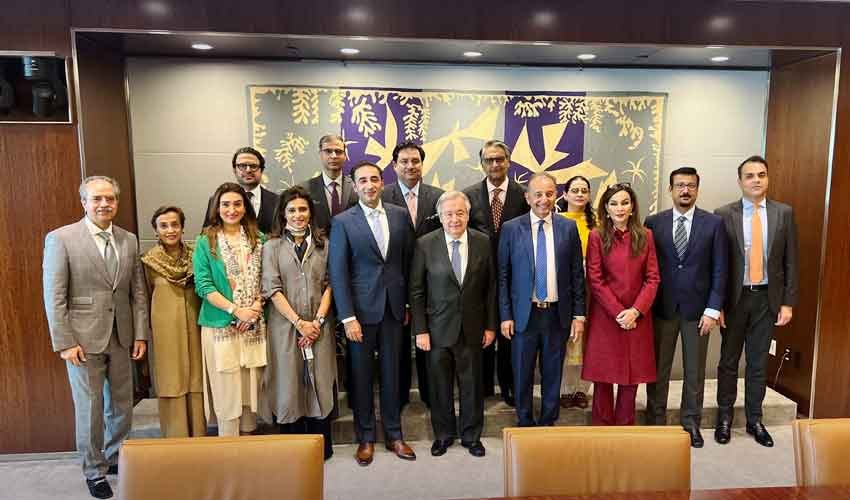

Pakistan’s former Foreign Minister and head of its UN diplomatic mission, Bilawal Bhutto-Zardari, has called for collaborative efforts between Pakistan and India to counter terrorism in South Asia. Speaking at a press conference at the United Nations Headquarters, Bilawal urged both nations to put aside their differences and have their intelligence agencies—Pakistan’s ISI and India’s RAW—work together to curb extremist threats in the region.
“The future of 1.5 billion people in South Asia cannot be held hostage by extremists and non-state actors,” Bilawal stressed. “If ISI and RAW sit together, terrorism can be significantly reduced.” He reiterated Pakistan’s willingness to cooperate with India on counterterrorism efforts, despite ongoing tensions.
Sharp Criticism of Indian Leadership
In a pointed critique, Bilawal compared Indian Prime Minister Narendra Modi to Israeli Prime Minister Benjamin Netanyahu, describing Modi as a “cheap copy” and accusing India of emulating what he termed as “aggressive and flawed” Israeli policies.
“Unfortunately, India is imitating everything that’s wrong,” he said, expressing concern that New Delhi’s current approach could deepen instability in the region.
Appeal for International Intervention
With tensions between the two nuclear-armed neighbors rising, Bilawal issued a plea to the international community to intervene before the situation escalates further.
“Every responsible nation must play its part in preserving peace,” he said. “A war between Pakistan and India would be a loss for the entire world. Global peace is a collective interest.”
He also denounced what he described as growing Indian aggression and strongly criticized Modi’s recent statements, labeling them “irresponsible, condemnable, and politically desperate.”
“No world leader speaks in such a tone. Modi’s remarks show pettiness and frustration,” Bilawal stated. “He is the first Indian prime minister to lose a war. We’ve shot down six Indian aircraft—this is a matter of record.”
Pakistan’s Fight Against Terrorism
Bilawal highlighted Pakistan’s domestic successes in the fight against terrorism, asserting that the country has made significant gains and remains committed to eradicating extremist groups.
“We’ve achieved major victories against terrorism inside our borders. We’ve made a national decision that there will be no space for such organizations, and we will defeat them again,” he declared.
He also pointed to the destabilizing effect of leftover American weaponry in Afghanistan, which he said continues to fuel regional instability.
In his remarks, Bilawal blended a call for cooperation with a critique of India’s current leadership, signaling both an openness to dialogue and a demand for change in regional behavior.
