

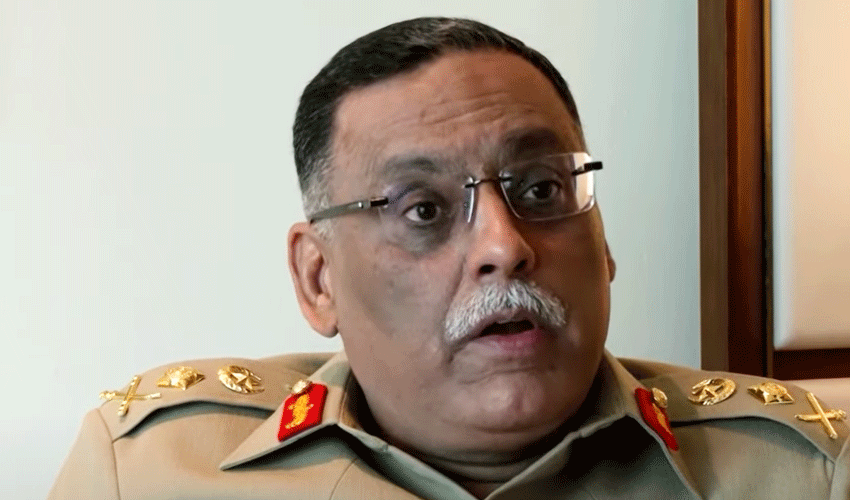

ISLAMABAD: Chairman Joint Chiefs of Staff Committee (CJCSC) General Sahir Shamshad Mirza has stated that Pakistan relied entirely on its resources during a recent 96-hour military confrontation with India, without seeking or receiving any external assistance.
In a rare interview with the BBC, Gen Shamshad refuted reports suggesting that allies such as China provided real-time intelligence or satellite support during the engagement.
“All the equipment used was either indigenously developed or procured earlier. But during the actual conflict, it was Pakistan’s own operational capability that was employed,” he said.
Providing rare insight into the brief but intense standoff between the two nuclear-armed neighbours, Gen Shamshad emphasized, “We managed the entire engagement independently. No help was requested, and none was received.”
Though he did not disclose the specific timing or operational details of the conflict, Gen Shamshad noted that unlike prior confrontations—often limited to the Line of Control—the recent hostilities had a broader reach, impacting urban centres more than border areas.
“There is relative calm along the borders for now, but the pressure in cities has increased. Future conflicts may not remain confined to traditional flashpoints,” he warned.
Touching on broader bilateral ties, the CJCSC highlighted the lack of structured communication between India and Pakistan, stating, “There is no effective or institutionalized mechanism to resolve disputes. At present, we rely solely on the DGMO-level hotline, which is not sufficient during times of crisis.”
Gen Shamshad also voiced concern over the growing influence of extremism in the region. “When dealing with extremist ideologies, the window for international diplomacy narrows. While the U.S. and a few others did attempt to mediate this time, even those channels are becoming increasingly limited,” he added.
India and Pakistan have long-standing tensions, particularly over the disputed territory of Jammu and Kashmir. Despite periodic calls for dialogue, relations remain strained, with recurring military incidents and diplomatic stand-offs. The last major escalation occurred in 2019 following the Pulwama attack and subsequent airstrikes.
