

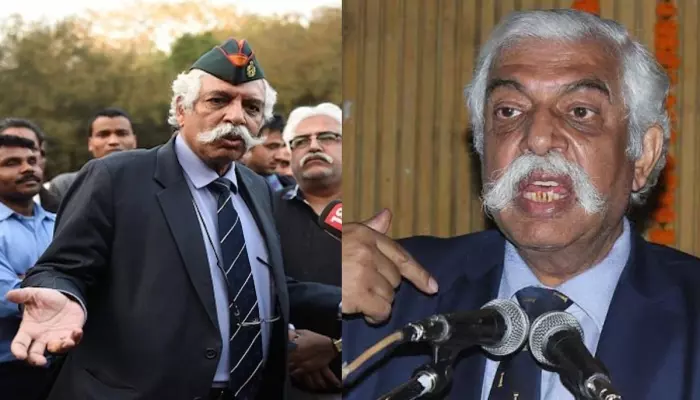

Beijing/New Delhi: A heated exchange unfolded during a live televised debate when Professor Victor Gao, Vice President of the Center for China and Globalization, sharply criticized retired Indian General G.D. Bakshi over his remarks on China-Pakistan relations.
The debate, initially intended as a platform for strategic discourse, took a confrontational turn after General Bakshi reiterated long-standing allegations against Pakistan, questioning its close ties with China.
Responding firmly, Professor Gao dismissed Bakshi’s claims and delivered a pointed rebuttal.
“General Bakshi, you need to study history. No power in the world can break the China-Pakistan friendship,” said Gao, calling into question the general’s understanding of the region’s diplomatic and defense history.
Professor Gao emphasized that the China-Pakistan alliance is not a recent development but a strategic partnership that spans decades. Describing it as a relationship “as solid as the rocks of the mountains,” he underlined that mutual trust, not short-term convenience, is the foundation of their bond.
He cited examples of joint military collaborations, including the co-development of fighter jets and deep-rooted defense ties, as evidence of enduring cooperation between the two nations.
“This is not a friendship born in May 2025 — it is a relationship of strategic significance that has been built over decades and cannot be shaken by external pressure,” Gao asserted.
Clash Over Terrorism Allegations
Tensions escalated further when General Bakshi labeled Pakistan a “hub of terrorism” and called for international action against it. Professor Gao strongly objected to the characterization, calling it “aggressive and irresponsible.”
“Labeling a sovereign nation a terrorist state and demanding immediate action is not diplomacy — it is provocation,” he said. “Such rhetoric fuels hostility rather than promoting understanding.”
Gao urged for a more balanced international approach, calling on nations to prioritize dialogue, evidence-based discourse, and peaceful resolution of conflicts rather than inflammatory accusations.
The verbal clash has drawn attention to the increasingly complex dynamics in South Asia, particularly the China-Pakistan-India triangle. Observers noted that Gao’s remarks echoed Beijing’s firm stance on its alliance with Islamabad, while the retired Indian general’s comments reflect persistent Indian security concerns.
Throughout the debate, as Gao backed his assertions with historical and strategic context, General Bakshi appeared visibly frustrated, often attempting to shift topics. The moment Gao told him to “study history” has since gone viral on social media, sparking intense debate among regional analysts and netizens alike.
The incident underscores the growing geopolitical tension in Asia, where narratives around alliances, historical ties, and security threats are increasingly contested on both diplomatic platforms and public forums.
