

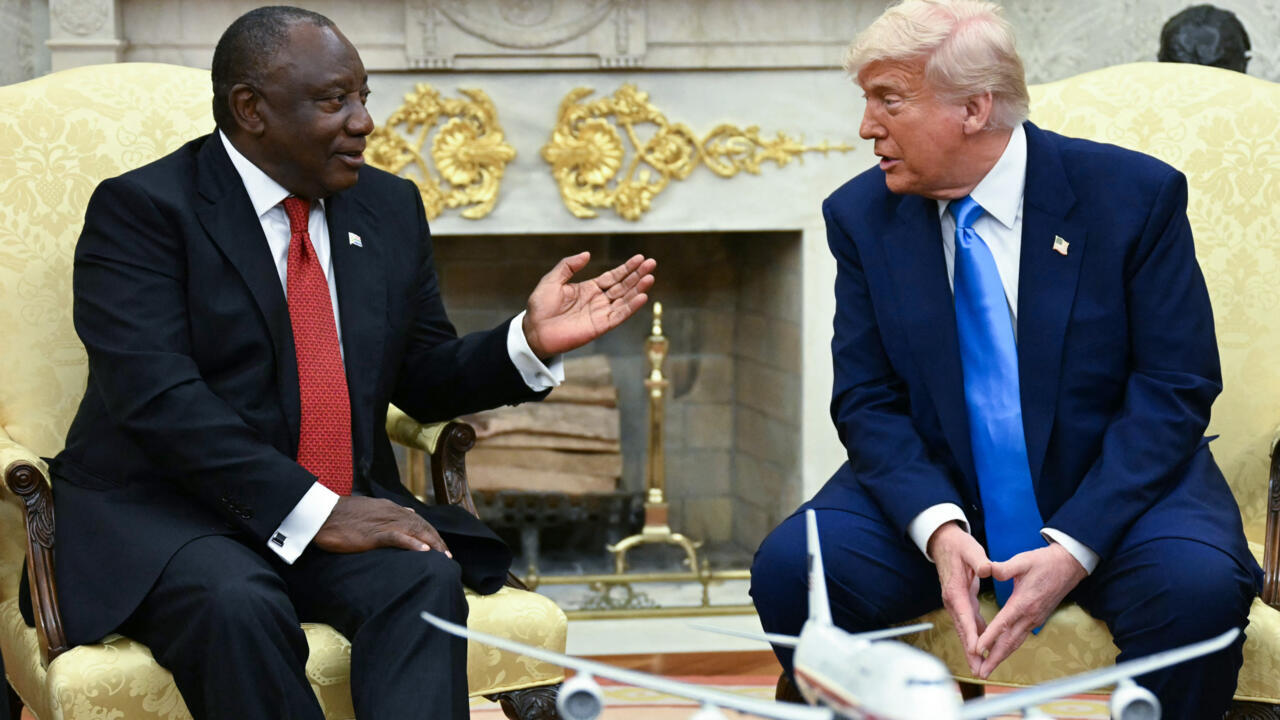

In a highly choreographed Oval Office encounter on Wednesday, U.S. President Donald Trump stunned South African President Cyril Ramaphosa by confronting him with debunked claims of genocide against white South Africans. The meeting, staged under dimmed lights and in front of cameras, echoed similar theatrics during Ukrainian President Volodymyr Zelensky’s visit earlier this year.
The scene, orchestrated by the White House, turned what was meant to be a diplomatic meeting into a public ambush, with Trump presenting videos and printed articles alleging mass killings and land seizures targeting South Africa’s white minority — claims widely dismissed as misinformation.
The incident marked another example of Trump’s willingness to use the Oval Office, a space traditionally reserved for respectful dialogue with foreign leaders, to push personal narratives and exert pressure on visiting dignitaries — particularly those from less powerful nations. Analysts warn such behavior could deter future visits and weaken U.S. diplomatic efforts, especially as rivals like China seek to expand their influence.
Patrick Gaspard, former U.S. ambassador to South Africa under President Obama, condemned the spectacle as “shameful,” accusing Trump of ambushing Ramaphosa with “fake snuff films and violent rhetoric.” He cautioned that engaging with Trump on his terms “never goes well for anyone.”
The meeting had been positioned as an opportunity to reset U.S.–South Africa relations, strained by Trump’s tariff policies and inflammatory rhetoric about so-called “white genocide” — including his suggestion to resettle white South Africans in the U.S.
Despite the hostile presentation, Ramaphosa remained composed. Though visibly prepared to rebut Trump’s assertions, he avoided direct confrontation, aware of the risks of challenging a notoriously thin-skinned president. In a moment of levity, he quipped, “I’m sorry I don’t have a plane to give you,” referencing a luxury jet reportedly offered to Trump by Qatar.
Vincent Magwenya, Ramaphosa’s spokesperson, later told Newzroom Afrika that the South African president “was clearly being provoked” but “did not fall for the trap.”
The White House did not respond to inquiries about whether the meeting was deliberately set up to pressure Ramaphosa — or if such tactics might discourage other leaders from engaging with Washington.
Cameron Hudson of the Center for Strategic and International Studies observed that while the encounter veered into political theatre, “it never crossed the line into anger or vitriol, so it didn’t go off the cliff.”
