

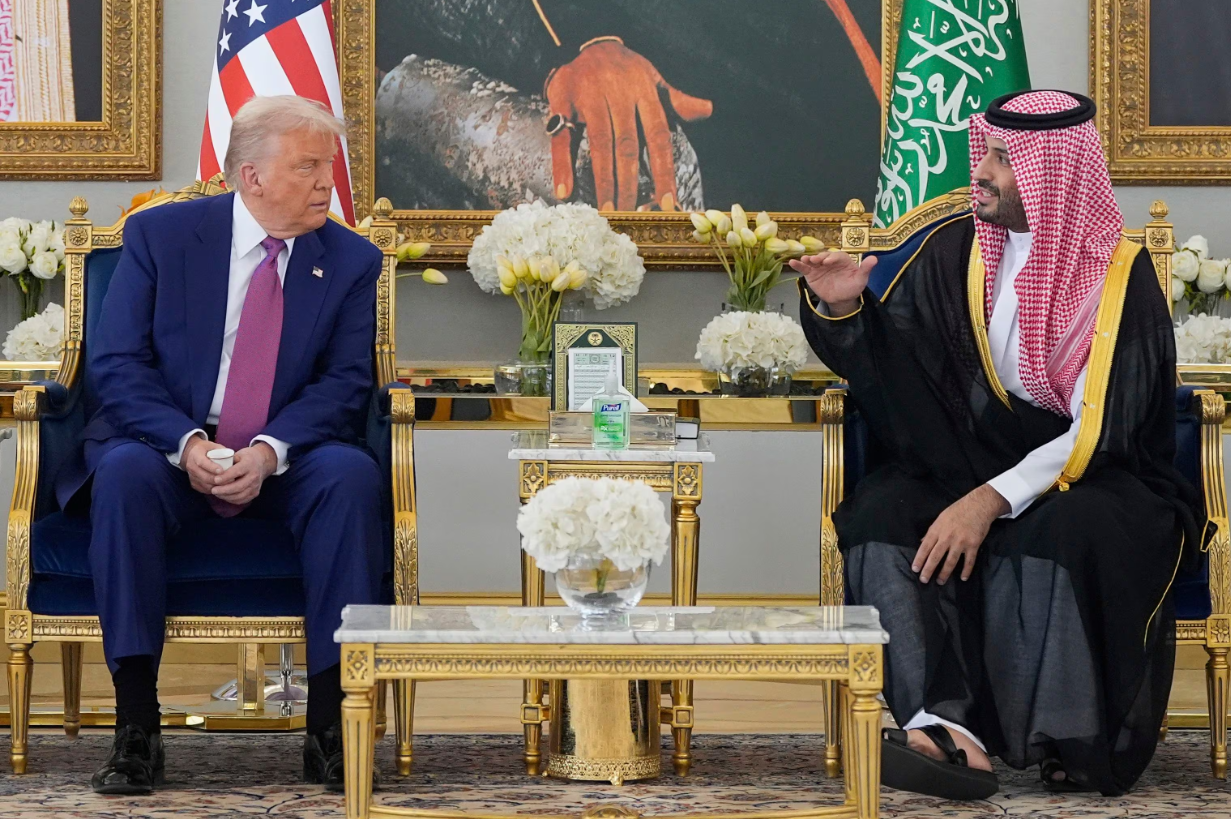

During a high-profile diplomatic tour of the Gulf, former U.S. President Donald Trump announced a dramatic shift in American foreign policy: the lifting of longstanding economic sanctions on Syria. The move coincided with the signing of a massive $142 billion arms deal with Saudi Arabia.
Speaking Monday in Riyadh — the first stop of his regional tour — Trump described Saudi Arabia as “our strongest partner,” underscoring a push to deepen economic and strategic ties between the United States and Gulf nations.
“The people of Syria now deserve a chance at greatness,” Trump declared, confirming the end of sanctions imposed over a decade ago in response to the Assad regime’s violent suppression of civil unrest. The decision comes in the wake of Bashar al-Assad’s ousting last year and the installation of a transitional government led by President Ahmed al-Sharaa, with whom Trump is scheduled to meet on Wednesday.
Standing alongside Saudi Crown Prince Mohammed bin Salman — who reportedly played a pivotal role in advocating for the sanctions’ removal — Trump quipped, “Oh, what I do for the crown prince,” alluding to Riyadh’s influence in the decision-making process.
Syria’s foreign minister, Asaad Shibani, welcomed the move as a “new start” for a nation devastated by 13 years of civil war. Former U.S. Ambassador to Syria Robert Ford echoed that sentiment, stating the end of the embargo would allow essential investment from Gulf nations to begin Syria’s long-delayed reconstruction.
The arms agreement with Saudi Arabia is among the largest U.S. defense deals in recent history and is part of a broader economic package that could eventually grow to $1 trillion in investments, according to Crown Prince Mohammed.
Trump’s Gulf tour mirrors his 2017 presidential trip, also launched in Riyadh, and will include further stops in Qatar and the United Arab Emirates. The tour aims to bolster U.S.-Gulf cooperation at a time of intensifying global competition in artificial intelligence and defense technologies.
The former president is accompanied by a high-profile delegation of U.S. business leaders, including Elon Musk, OpenAI CEO Sam Altman, BlackRock Chairman Larry Fink, and Nvidia CEO Jensen Huang. Their presence signals a deepening alignment between American innovation and Gulf investment — particularly in emerging technologies.
Huang announced that Nvidia will provide over 18,000 of its latest AI chips to Saudi AI firm Humain, advancing the Kingdom’s Vision 2030 strategy to diversify away from oil dependence.
In his speech, Trump also expressed hope that Saudi Arabia might join the Abraham Accords — the normalization agreements with Israel initiated during his presidency. However, Crown Prince Mohammed reiterated that any such agreement hinges on a lasting resolution to the Gaza conflict and the establishment of a Palestinian state.
