


Political Leaders
Political leaders in Pakistan have issued a wave of strong reactions to Indian Prime Minister Narendra Modi’s first public address following several days of intense military clashes between the two countries, which ended under a ceasefire brokered by the United States.
Modi, while speaking today, warned that India would once again strike what he termed “terrorist hideouts” inside Pakistan if another attack were to occur, declaring that India would not be deterred by what he described as Pakistan’s “nuclear blackmail.”
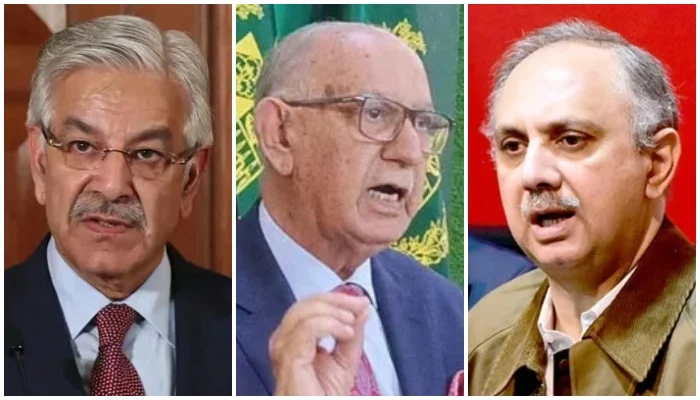
Responding sharply to these remarks, Pakistan’s Defence Minister Khawaja Asif criticized Modi’s tone and rhetoric, describing him as a “defeated gambler” who had lost all credibility. Asif pointed out that Modi’s speech was an implicit admission that issues like Kashmir and terrorism remain legitimate subjects for dialogue between the two countries.
He claimed that Pakistan had emerged stronger and more united following the recent conflict and declared that Islamabad would demand an independent investigation into the April 22 Pahalgam attack if New Delhi continues to raise the issue of terrorism.
Opposition Leader in the National Assembly Omar Ayub Khan also condemned Modi’s statements, referring to the Indian leader as a “fascist” and challenging him to follow through on his threats if he had the courage. Omar added that the Pakistani nation stood united and would not allow Modi to succeed in what he called “nefarious plans” against Pakistan.
PML-N Senator Irfan Siddiqui also weighed in, characterizing Modi’s speech as a “clear admission of humiliating defeat.” Speaking to reporters in Islamabad, Siddiqui said the Indian Prime Minister’s body language reflected weakness and desperation. “After such disgrace, silence would have been more dignified than this display of bluster,” he remarked.
The recent ceasefire, which was announced over the weekend, has held firm through Monday. It followed four days of the worst military escalation between the two nuclear-armed neighbors since the Kargil conflict in 1999.
According to U.S. President Donald Trump, the truce was the result of intense diplomatic efforts by Washington. Trump stated on Monday that U.S. intervention had prevented a “bad nuclear war” and potentially saved millions of lives. “We stopped a nuclear conflict… so I’m very proud of that,” he said at the White House.
The ceasefire was announced after Pakistan launched a large-scale retaliatory campaign named “Operation Bunyan-um-Marsoos,” targeting Indian military sites across multiple regions.
Pakistani officials described the strikes as “precise and proportionate,” asserting they were in response to India’s unprovoked missile attacks on several Pakistani cities during the nights of May 5 and 6.
While India claimed these attacks were aimed at neutralizing terrorist targets following the Pahalgam incident in Indian Illegally Occupied Jammu and Kashmir (IIOJK), Pakistani authorities reported civilian casualties and damage to infrastructure, which further inflamed tensions and triggered the retaliatory response.
