

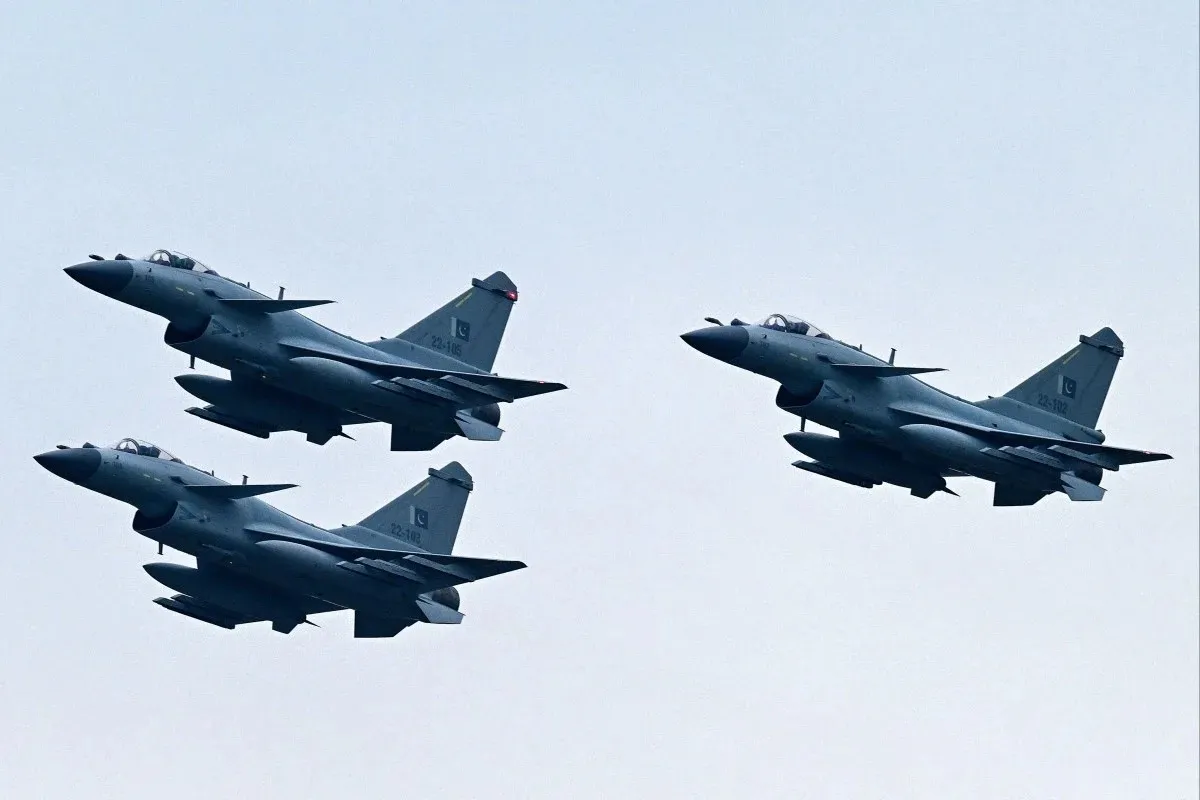

A recent military escalation between Pakistan and India, both nuclear-armed nations, has signaled a possible turning point in regional warfare dynamics and global defense alliances.
For the first time in recorded conflict, India’s French-built 4.5-generation Rafale fighter jets were downed during combat. This confrontation marked a significant departure from past engagements, where Pakistan had typically relied on U.S.-supplied weaponry. In contrast, India has gradually pivoted from Russian military systems to those from Western countries.
What makes this clash particularly significant is the introduction of China’s advanced PL-15 air-to-air missiles into live combat. The incident is increasingly viewed as a real-world demonstration of Chinese versus Western aerospace technologies—highlighting the evolving geopolitical alignment in the global defense sector and potentially intensifying competition in the international arms market.
Visuals circulating online show fragments resembling the Chinese-made PL-15 missile, including parts of its fuselage with visible serial numbers and a seeker assembly believed to use an active electronically scanned array (AESA) radar. This radar system is known for high tracking accuracy and resilience against electronic jamming.
Developed by China’s Aviation Industry Corporation (AVIC), the PL-15 is a long-range, radar-guided missile engineered to target high-value enemy aircraft from over 200 kilometers away. Its export version, the PL-15E, has a reported range of 145 kilometers and is integrated with Pakistan’s JF-17 Block III and J-10CE fighter jets. The version used by China’s air force is believed to offer a significantly longer range of 300–500 kilometers.
Pakistan’s military released imagery on April 26 showing its JF-17 fighters equipped with both PL-15E and short-range PL-10 missiles. The country’s current air fleet includes approximately 45–50 JF-17 Block IIIs and around 20 J-10CE aircraft, all capable of launching the PL-15E.
The PL-15 missile incorporates advanced guidance systems, including inertial navigation, Beidou satellite updates, two-way datalink communication, and AESA radar terminal homing. Propelled by a dual-pulse solid rocket motor, it can reach speeds over Mach 5 and carries a high-explosive fragmentation warhead weighing between 20 and 25 kilograms.
Unverified reports suggest the PL-15s may have been supplied directly by China’s air force, indicating deeper operational collaboration. Indian air defenses, including Rafales armed with Meteor missiles, Su-30MKIs using R-77s, and S-400 surface-to-air missile systems, now face a potential challenge due to the extended reach of the PL-15.
Though Pakistan officially confirmed the use of Chinese-made J-10C fighter jets during the encounter, it has not publicly identified the specific munitions employed. However, debris believed to be from a PL-15 missile was reportedly recovered in Hoshiarpur, located in India’s Punjab state. If verified, this would mark the first documented combat use of the PL-15 missile.
Further reports suggest that at least two Indian military aircraft were downed by a Chinese-made fighter jet operated by Pakistan, reflecting a significant milestone for China’s defense exports and aerospace capabilities.
This development adds urgency to regional air defense strategies and showcases the divergent procurement paths of the two South Asian rivals—India with a diversified supplier base, and Pakistan increasingly relying on a China-centric arsenal.
The presence of the PL-15E missile in an actual combat scenario is likely to provide China with valuable operational data and bolster its position in the global defense export market. While neither Islamabad nor Beijing has formally acknowledged the missile’s use, the implications of its deployment are already being closely watched by military analysts and strategic planners.
The PL-15’s performance introduces a new dimension to modern air combat in the region, posing a direct challenge to established systems like the U.S.-made AIM-120D and the European Meteor. Although the Meteor is favored for its extended no-escape zone and ramjet propulsion, the PL-15 offers superior first-strike potential due to its longer range and advanced radar capabilities when fired from stand-off distances.
