


DG ISPR
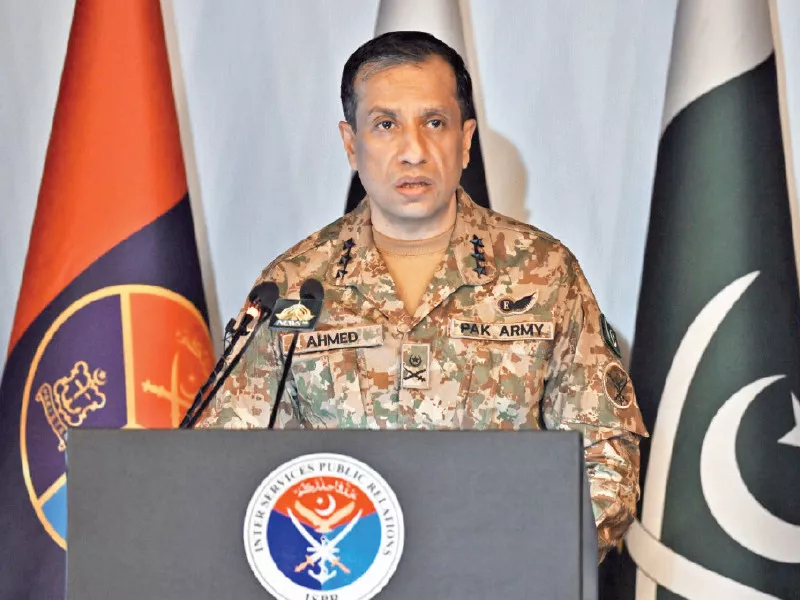
Director General Inter-Services Public Relations (DG ISPR), Lieutenant General Ahmed Sharif Chaudhry, issued a firm warning on Thursday, stating that Pakistan’s retaliation to any future Indian aggression would be powerful enough to reverberate across the globe—without the need for formal announcements.
Addressing a joint press conference alongside Deputy Prime Minister and Foreign Minister Ishaq Dar, the military spokesperson stressed that Pakistan’s response would be so decisive and unmistakable that “the entire world would hear its echo.”
“When Pakistan strikes, it will be unmistakable and undeniable. You won’t need the media to explain — the impact will speak for itself,” said Lt Gen Ahmed. His remarks came in the wake of recent hostilities triggered by India’s strikes on Pakistani territory, including Azad Jammu and Kashmir (AJK), which Islamabad described as a blatant act of war.
According to Pakistani authorities, six separate locations—Ahmedpur East, Muridke, Sialkot, and Shakkargarh in Punjab, along with Muzaffarabad and Kotli in AJK—were targeted by Indian forces. The attacks resulted in the martyrdom of at least 31 civilians, including children, and left 57 others injured. Civilian infrastructure such as mosques and hydropower projects were among the targets.
In response, Pakistan’s armed forces downed five Indian Air Force jets, shot down seven drones, and destroyed a brigade headquarters along with multiple Indian checkposts across the Line of Control (LoC). India later accused Pakistan of launching attacks on 15 cities using drones and missiles. However, the DG ISPR dismissed these allegations as “utterly false,” accusing India of fabricating evidence to justify its aggression.
“The images India presented as proof are laughable,” said Lt Gen Ahmed. “A real projectile would have at least scorched the ground, but there’s no such evidence in their photos.” He also questioned India’s defense claims: “If India says it neutralised 15 projectiles, why couldn’t it prevent its own five aircraft—including Rafale, MiG-29, and SU-30 jets—from being shot down by the Pakistan Air Force?”
The military spokesman revealed that one Indian missile entered Pakistani airspace and was successfully intercepted, with its debris landing in Denga. The remaining projectiles were launched on Amritsar, which Pakistan claims India attacked itself to provoke anti-Pakistan sentiment among the Sikh community.
Foreign Minister Ishaq Dar echoed these sentiments, accusing the Modi-led government of using Amritsar as a pawn in a larger communal strategy. “India is attempting to create hatred among its own Sikh population by blaming Pakistan for a strike it orchestrated itself,” Dar said. He described this act as “deeply insidious,” aimed at diverting attention from domestic unrest and the communal divisions growing within Indian society.
He further emphasized that Pakistan denies any involvement in actions that would endanger civilians in Indian Punjab. “Unlike India’s divisive Hindutva-driven agenda, Pakistan is committed to protecting innocent lives and maintaining regional peace,” Dar concluded.
