


US-China Trade Strains
Australia’s newly re-elected Labor government has placed the escalating US-China trade conflict at the forefront of its foreign policy agenda, signaling a strategic shift amid growing global economic uncertainty. Treasurer Jim Chalmers emphasized this priority on Sunday, highlighting the economic and geopolitical pressures facing the country.
With the international landscape becoming increasingly volatile, Canberra is preparing to play a stabilizing role, particularly as tensions between the world’s two largest economies continue to impact global markets.
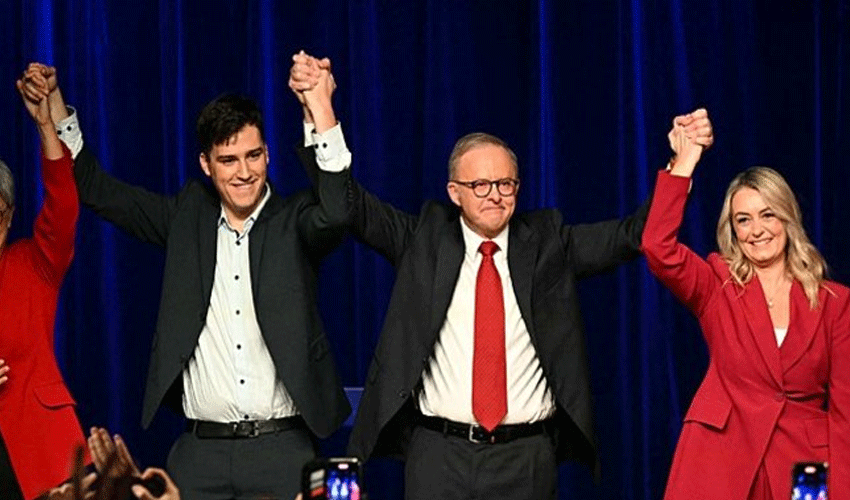
Following a convincing electoral win, Prime Minister Anthony Albanese assured the public of his government’s commitment to steady, responsible leadership. “This government will continue with the calm and considered leadership that Australians have voted for,” Albanese said in a brief appearance in his Sydney electorate. He reaffirmed that the people of Australia had chosen unity over division, underlining the Labor Party’s mandate to lead with discipline and order.
The Labor Party appears set to expand its parliamentary majority, with the Australian Broadcasting Corporation (ABC) projecting the party to win at least 85 seats in the 150-member House of Representatives—up from the 77 it held previously. While final vote counting will resume on Monday, more than two-thirds of ballots have already been processed, confirming a strong performance for the centre-left party.
This victory marks a significant milestone for Albanese, who becomes the first Australian prime minister in two decades to secure a second consecutive term. It also strengthens Labor’s position to shape Australia’s domestic and international policies at a critical time.
Treasurer Chalmers acknowledged the external pressures weighing on the economy, pointing specifically to the strained relationship between the US and China. He noted that recent actions by the US—especially under President Donald Trump—such as the April 2 tariff announcement, had heightened global economic anxiety and raised concerns over the security of Australian investments, including pension funds.
Although the campaign initially focused on domestic issues like the cost of living, the international dimension gained prominence as voters responded to growing geopolitical threats. Labor’s surge at the polls was unexpected, particularly after trailing in opinion surveys for nine consecutive months.
However, public opinion began to shift in March following the conservative opposition’s announcement of controversial policies, including significant cuts to the federal workforce and mandatory full-time office attendance—measures criticized for disproportionately affecting working women.
The opposition’s defeat was compounded by the loss of its leader, Peter Dutton, who failed to retain his seat. The moment drew comparisons to recent political events in Canada, where the conservative party leader suffered a similar electoral blow.
Former conservative MP Keith Wolahan reflected on the defeat, acknowledging a disconnect between his party and urban voters. “It’s clear our party has an issue in urban Australia, which is where most people live,” he said, urging introspection within the conservative ranks.
With a stronger mandate, the Labor government is poised to approach both domestic governance and international diplomacy with renewed confidence. Prime Minister Albanese has pledged to safeguard Australia’s economic resilience and enhance its role in promoting stability in a world increasingly shaped by great power rivalries.
The second term of Labor leadership is expected to be defined by its response to these global challenges and its ability to balance internal demands with external responsibilities.
