

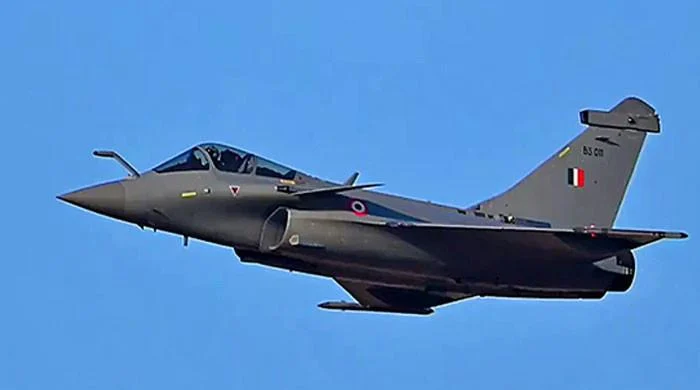

Rafale
Following the Pahalgam incident, tensions have escalated along the Pakistan-India border, with India engaging in provocative and aggressive maneuvers.
Despite these attempts, Pakistan has demonstrated maturity and strategic restraint, responding with timely and effective defensive actions to prevent any violation of its territorial integrity.
In the latest development, the Pakistan Air Force (PAF) successfully thwarted an Indian attempt to advance towards Pakistani airspace on the night between April 29 and 30.
According to reliable sources, four Indian Rafale fighter jets took off from Ambala air base in Haryana and flew toward Pakistan at a ground speed of 1,200 kilometers per hour. Although the jets did not enter Pakistani airspace, their close proximity and capability to strike targets from a distance made the move a serious security threat.
The Rafale aircraft were reportedly armed with Spice 2000 air-to-ground missiles, each with a range of 200 kilometers—making it possible for India to conduct cross-border strikes without physically entering Pakistan’s airspace.
However, Pakistan’s Electronic Warfare and Air Defence Systems swiftly neutralized the threat. By jamming the Rafales’ onboard radar, sensors, and communication systems, the PAF disrupted coordination between the aircraft and with their command centers. As a result, the Indian pilots were forced to make emergency landings in Srinagar instead of returning to Ambala.
Simultaneously, the PAF scrambled its J-10C fighter jets, equipped with PL-15 beyond-visual-range missiles with a 230-kilometer reach, effectively outmatching the Indian Rafales. This confrontation marked another strategic victory for the PAF, comparable to its successful engagement against the Indian Air Force in 2019, when Indian pilot Abhinandan was captured.
In a second reported provocation, India allegedly prepared for another operation on Friday. In response, Pakistan launched 40 to 50 aircraft—including F-16s, JF-17s, and J-10Cs—into the skies, compelling the Indian Air Force to abort its plan.
Sources emphasize that Pakistan’s superiority in electronic, cyber, and space warfare has been crucial in maintaining strategic dominance. Despite India’s reliance on technologically advanced Rafale jets, its efforts have repeatedly failed due to the preparedness and multi-domain capabilities of the PAF.
Once again, India’s ambitions have been thwarted—underscoring that modern machinery alone cannot secure victory without strategic foresight and electronic warfare dominance, both of which Pakistan continues to command.
