

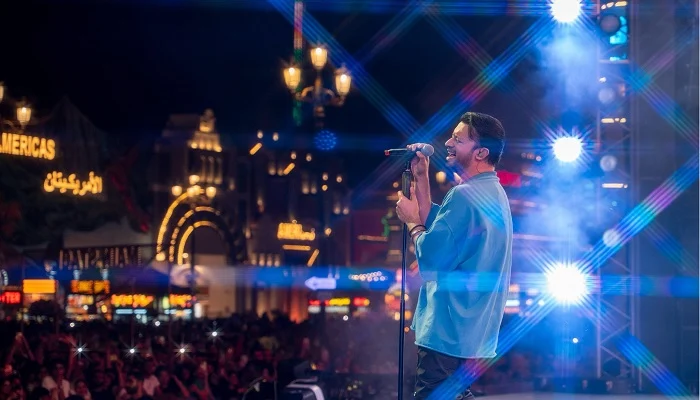

DUBAI: Amid rising tensions between India and Pakistan, music proved to be a powerful unifier as renowned Pakistani singer Atif Aslam brought together fans from both nations during a vibrant performance at Dubai’s Global Village.
As diplomatic hostilities continue to grow, particularly following the Pahalgam attack and India’s suspension of the Indus Waters Treaty, Atif’s concert stood out as a rare moment of cultural harmony. The event drew a large, mixed crowd of Indian and Pakistani expatriates who set aside political differences to celebrate a shared love for music.
Over the course of two hours, Atif performed a dynamic set featuring hits in Urdu, Hindi, Punjabi, and English. Songs like “Pehli Nazar Mein”, “Woh Lamhe”, “Ek Pyar Ka Nagma Hai”, and “Lambi Judai” drew roaring applause from the audience, who sang along and danced together in a show of cross-border solidarity.
“It felt like a celebration of unity, not division,” said one concertgoer, emphasizing that music had once again transcended politics.
Despite strained diplomatic ties, particularly in the wake of India’s unilateral actions in Jammu and Kashmir and its growing political hostility toward Pakistan, events like this highlight the enduring cultural connection between the people of both countries. Observers noted that Atif Aslam’s concert sent a quiet but powerful message—that ordinary people reject divisive, nationalistic rhetoric and yearn for peace.
Kris Aslam, one of the event organizers, echoed this sentiment. “Dubai, with its diverse and inclusive spirit, has always provided a neutral space where art can thrive beyond politics,” he said. “It’s moments like these that remind us of our shared heritage.”
This cultural unity stands in stark contrast to recent political decisions, such as India’s refusal to send its cricket team to Pakistan for the 2025 Champions Trophy and barring team captain Rohit Sharma from attending a group photo in Lahore with other captains—a move widely criticized as contrary to the spirit of sportsmanship.
Despite these setbacks, fans and artists alike continue to prove that the bonds of music, art, and culture often run deeper than the divisions of state.
