

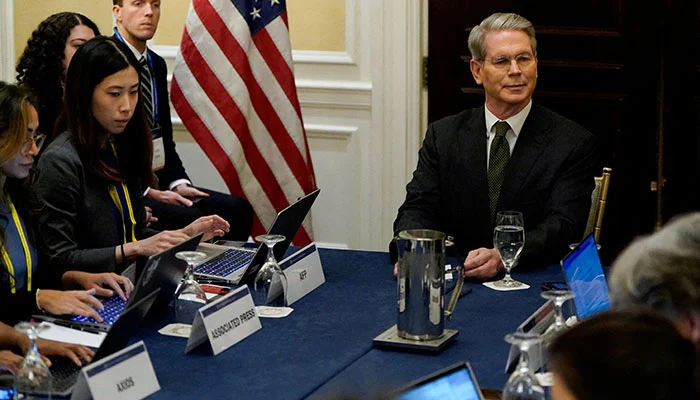

U.S. Treasury Secretary Scott Bessent has sharply criticized the International Monetary Fund (IMF) and World Bank, asserting that both institutions have drifted from their primary mandate of supporting global economic growth and financial stability.
Speaking during the Spring Meetings of the IMF and World Bank in Washington, Bessent emphasized that the two global financial entities need significant reforms to restore U.S. trust. He expressed concern over what he described as a disproportionate focus on social issues such as climate change and gender equality, urging a return to core objectives.
“The IMF and World Bank must be reoriented to fulfill their original purposes,” Bessent said at the Institute of International Finance Global Outlook Forum. He added that the U.S. administration is open to collaboration with the institutions—provided they stick to their economic roles.
Bessent argued that the IMF should concentrate on promoting monetary cooperation and financial stability, rather than lending to countries that are not committed to reforms. “The measure of IMF success should be stability and growth, not the volume of its lending,” he said.
He also urged the World Bank to prioritize fundamental goals such as poverty reduction, economic development in low-income nations, and mobilizing private investment. He criticized what he described as “buzzword-driven” initiatives lacking substantive reform and accountability.
The Treasury Secretary said that while he had already discussed these concerns with IMF Managing Director Kristalina Georgieva and World Bank President Ajay Banga, his comments came as no surprise to them. “They are capable leaders,” he noted, “and I hope their future actions will justify the administration’s confidence.”
Bessent called for more efficient use of World Bank resources, especially in supporting emerging economies with practical energy solutions. He suggested the bank consider greater support for reliable sources, such as natural gas and nuclear energy, rather than being guided by climate finance targets he described as “distortionary.”
He also called for timelines for phasing out development aid to countries like China, which he argued no longer fit the traditional definition of a developing economy.
On the IMF’s recent downgrade of U.S. economic growth projections, Bessent remained unfazed, predicting that greater clarity on tariffs and the effects of deregulation would become evident by the third quarter of the year.
