

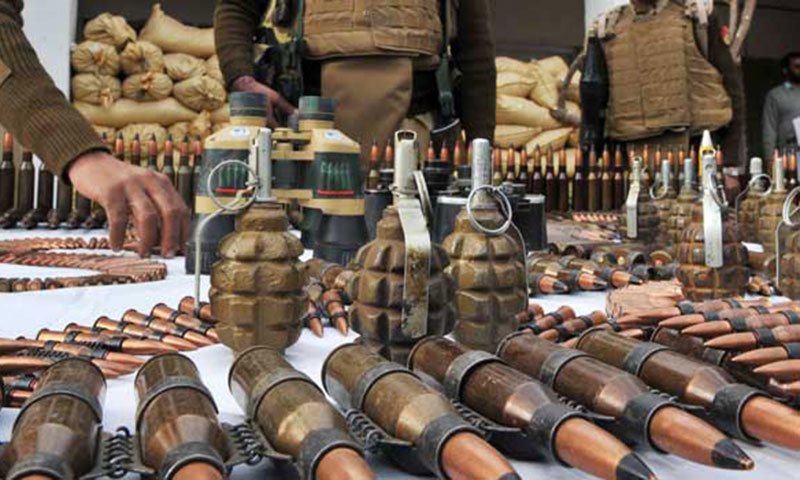

A new report by the Small Arms Survey, a Geneva-based organization, highlights the persistent and illicit trade of small arms and light weapons along the Afghanistan-Pakistan border.
Arms Trafficking Remains Rampant
Titled “Documenting Arms Availability in Afghanistan”, the report reveals that Soviet-era and NATO-pattern weapons remain widely accessible in informal markets, despite Taliban efforts to regulate arms distribution.
Field research (2022–2024) in Afghanistan’s eastern provinces and Pakistan’s tribal districts found that while the Taliban has imposed restrictions on civilian arms possession, weapons continue to circulate—often with local Taliban officials’ tacit approval. These arms frequently fall into the hands of non-state groups such as Tehreek-e-Taliban Pakistan (TTP) and al-Qaeda, posing a serious regional security risk.
Weapon Prices Soar Amid Supply & Demand Shifts
Since the Taliban’s takeover in 2021, the availability and pricing of weapons have fluctuated:
- NATO-pattern weapons, like the M4 and M16 rifles, have surged in price—M4s by 13% and M16s by 38% in Afghanistan’s Nangarhar and Kunar provinces.
- Soviet-era AK-47s remain affordable and stable in price, indicating a steady supply.
- NATO weapons in Pakistan are significantly cheaper than in Afghanistan, with M4s priced between $3,325 and $3,700 in Pakistan versus $3,722 in Nangarhar.
Smuggling Routes & Market Dynamics
The study, conducted in Khost, Kunar, Bajaur, Khyber, and North Waziristan, found that arms smuggling remains active and adaptive. Demand from groups like TTP and the Haqqani Network has driven up prices, particularly in conflict-prone areas like Khost and Nangarhar.
The report underscores that arms proliferation remains a major security concern, with price fluctuations and supply chains reflecting shifting geopolitical dynamics in the region.
