

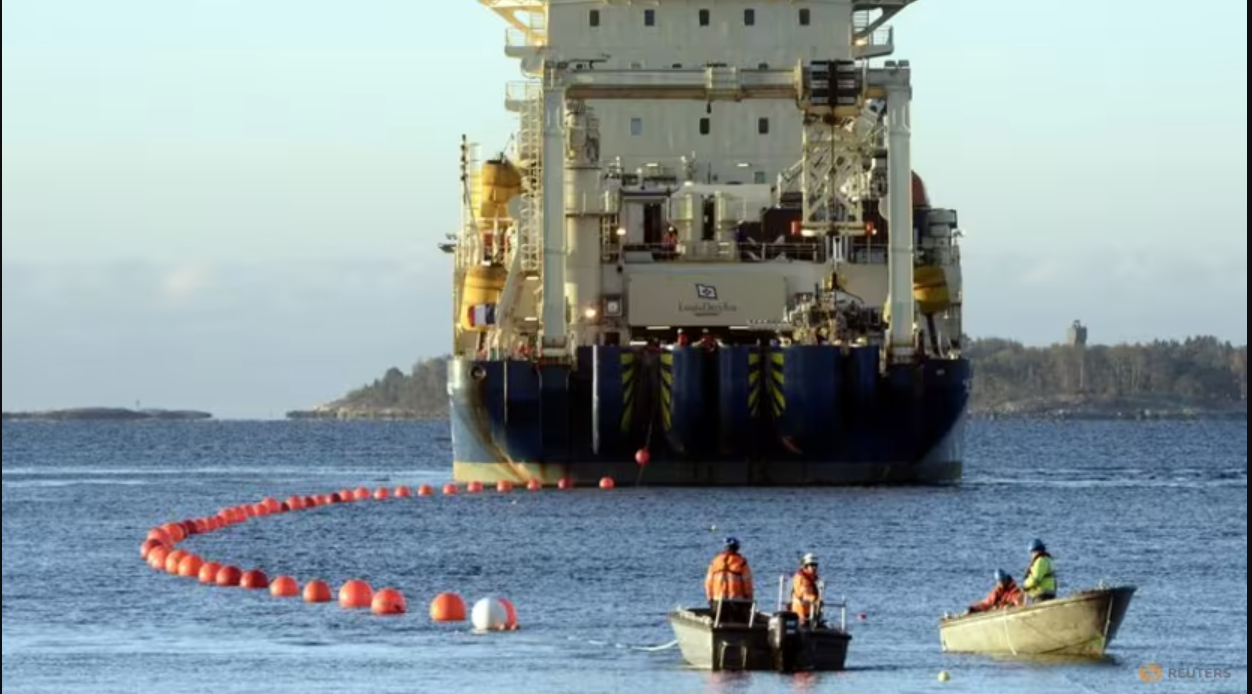

When Taiwan intercepted a Chinese-crewed cargo vessel suspected of deliberately cutting an undersea communications cable last month, authorities vowed to fully investigate the incident.
The Taiwan Coast Guard Administration indicated that the Togo-flagged ship, Hong Tai 58, might have been deployed as part of a covert incursion. This incident adds to a growing number of undersea cable disruptions in both Taiwan and Europe, highlighting the challenges of proving sabotage and holding perpetrators accountable.
Since 2023, at least 11 cases of undersea cable damage have been recorded around Taiwan, with an equal number reported in the Baltic Sea. Authorities in both regions suspect China and Russia—nations with increasingly tense relations with Western countries—of involvement, although some incidents have been attributed to natural causes.
In response, NATO launched Baltic Sentry to monitor suspicious maritime activity. Despite detaining several vessels and crews, including the Hong Tai 58 near Taiwan’s outlying islands on February 25, no official charges have been filed against individuals or companies. Meanwhile, both Beijing and Moscow have denied any involvement in undersea cable sabotage.
Challenges in Proving Sabotage
Undersea cables, responsible for transmitting 99% of intercontinental digital communications, frequently sustain damage due to aging, environmental changes, and maritime activities like fishing. Annually, between 100 and 200 cable faults occur worldwide, leading to industry-wide redundancy measures to ensure continued connectivity.
However, these cables have also become targets for hybrid warfare—low-level, deniable acts of coercion. Security experts note that the recent pattern of cable disruptions exhibits signs of deliberate interference.
Most undersea cable damage results from accidents, such as dropped anchors or fishing nets dragging cables. However, intelligence analysts point out statistical anomalies in recent incidents, including multiple simultaneous breaks and the proximity of suspicious vessels.
One such case involved the Shun Xing 39, a Cameroon-flagged vessel suspected of damaging the Trans-Pacific Express cable, which links Taiwan to the U.S. west coast. Although authorities attempted to inspect the ship, poor weather conditions prevented boarding, allowing it to continue its journey to South Korea.
Similarly, European authorities investigated the Chinese-flagged Yi Peng 3 after two cables were severed in November—one linking Finland to Germany and another connecting Sweden to Lithuania. Data showed the vessel slowing near the cables at the time of the breaks, with sonar images indicating that its anchor had dragged across the seabed for approximately 160 kilometers (99 miles).
Despite this evidence, enforcement proved difficult. Operating under the flag of China and anchored in international waters, the Yi Peng 3 remained beyond the jurisdiction of European authorities. While China agreed to conduct its own investigation and allowed European representatives to board as observers, no legal action was taken.
Legal and Jurisdictional Barriers
Enforcing maritime laws in international waters remains complex due to overlapping jurisdictions. Under the United Nations Convention on the Law of the Sea (UNCLOS), vessels in international waters are generally subject to the laws of their registered flag state. Authorities can exercise universal jurisdiction only in specific cases such as piracy, terrorism, or slavery. Some countries extend their jurisdiction if their citizens are affected by a crime, but proving sabotage remains challenging.
Building a legal case for deliberate interference requires substantial evidence, such as intercepted communications confirming orders to damage cables. Experts believe that obtaining such proof is difficult, further complicating efforts to prosecute suspects.
Ongoing Incidents and Strategic Implications
Even after the Yi Peng 3 left European waters, undersea cable disruptions in the Baltic Sea continued. One notable case involved the suspected Russian oil tanker Eagle S, flying the Cook Islands flag. On December 25, the vessel allegedly dragged its anchor for 100 kilometers (62 miles), damaging cables in the Gulf of Finland. Unlike previous cases, Finnish authorities managed to impound the ship within their territorial waters, imposing a travel ban on three crew members while launching a criminal investigation.
Intelligence agencies warn that such activities may escalate. With shifting geopolitical dynamics, including efforts to negotiate an end to the Russia-Ukraine conflict, some analysts predict that Russian intelligence and military proxies could intensify acts of sabotage.
The repeated incidents of cable disruptions indicate a broader strategic effort by states seeking to exert influence while maintaining plausible deniability. Experts argue that until the international community formulates a decisive response, these acts will likely persist.
