


NATO Allies
WASHINGTON: Former US President Donald Trump has once again cast doubt on Washington’s commitment to defending its NATO allies, stating that the United States would not provide military protection to members who fail to contribute their fair share to the alliance’s defense spending.
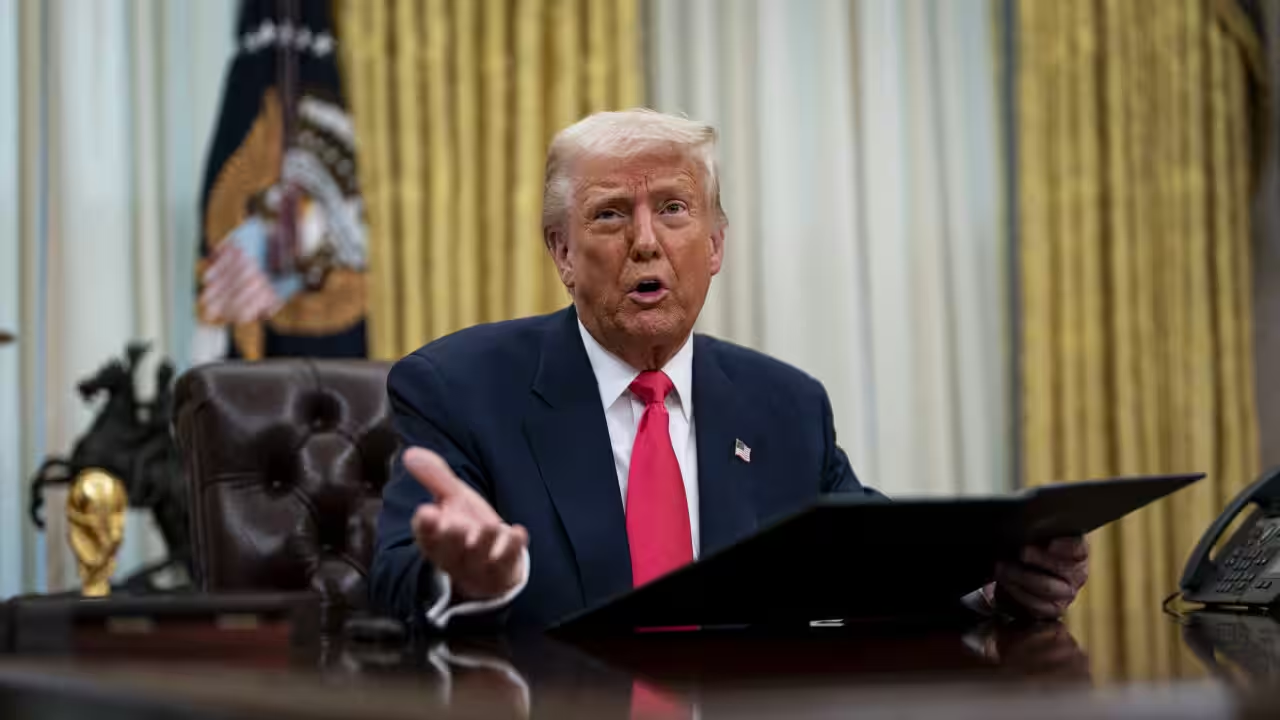
Speaking to reporters in the Oval Office on Thursday, Trump reiterated his long-held stance, declaring, “If they don’t pay, I’m not going to defend them. No, I’m not going to defend them. It’s common sense, right?” He emphasized that during his previous tenure from 2017 to 2021, he had repeatedly urged NATO members to increase their defense spending.
While some allies responded by raising their contributions, Trump argued that the current level of spending remains insufficient. “Even now, it’s not enough,” he stated. “They should be paying more.”
Trump’s remarks could create unease among US allies, particularly in Europe and Asia, where leaders are already apprehensive about the future of American security commitments. His comments come at a time when NATO is marking its 75th anniversary, a milestone that underscores the alliance’s historical mission of collective security, particularly in deterring threats from Russia and other adversaries.
NATO’s Secretary General Mark Rutte sought to reassure members by reaffirming the alliance’s strength and the enduring transatlantic relationship. “I know some may have concerns about NATO’s future,” Rutte said on Thursday. “So let me be clear: the transatlantic partnership remains the bedrock of our alliance.
President Trump has made clear his commitment to NATO, and he has also made clear his expectation that we in Europe must do more in terms of defense spending.”
Despite these reassurances, Trump questioned whether NATO members would reciprocate the US’s commitment in times of crisis. He specifically singled out France and a “couple of others,” suggesting that their willingness to protect the United States remained uncertain. “You think they’re going to come and protect us? They’re supposed to,” he remarked. “I’m not so sure.” While he described NATO as “potentially good,” he insisted that the alliance’s financial imbalance needed to be addressed. Additionally, he accused NATO allies of exploiting the US in trade, saying, “They’re screwing us on trade.”
Trump’s stance on NATO contrasts with his recent affirmation of the US’s commitment to the alliance. Just last week, while standing alongside British Prime Minister Keir Starmer, he reaffirmed US support for NATO’s mutual defense obligations.
US-Iran Nuclear Tensions
In addition to his comments on NATO, Trump also addressed concerns about Iran’s nuclear program, revealing that he had sent a letter to Iranian authorities urging them to engage in negotiations. He warned that failure to do so could result in potential military action from the US.
“I’ve written them a letter, saying I hope you’re going to negotiate because if we have to go in militarily, it’s going to be a terrible thing for them,” Trump told Fox Business in an interview aired on Friday. “You can’t let them have a nuclear weapon.”
However, Iran’s mission to the United Nations in New York stated on Friday that Tehran had not yet received any such letter from Washington.
Trump’s approach to Iran has been marked by hostility since his first term in office when he withdrew the US from the landmark 2015 nuclear agreement known as the Joint Comprehensive Plan of Action (JCPOA).
The deal had imposed strict limitations on Iran’s nuclear activities in exchange for sanctions relief. However, after the US exited the agreement in 2018, Iran gradually scaled back its commitments.
Following the withdrawal, Trump reintroduced severe economic sanctions under his “maximum pressure” strategy, accusing Iran of pursuing nuclear weapons. Tehran, in turn, maintained that its nuclear program was for peaceful purposes. The latest warning from Trump signals continued tensions between Washington and Tehran, with the possibility of escalating conflict if diplomatic efforts fail.
