

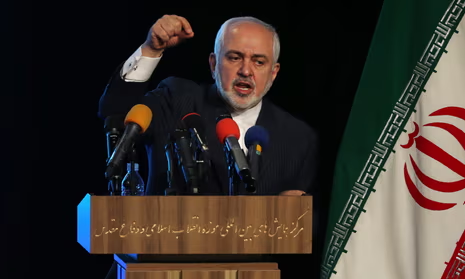

Javad Zarif
Iran’s Deputy President for Strategic Affairs, Javad Zarif, has announced his resignation following a prolonged legal and political controversy surrounding his appointment.
The former foreign minister, who played a pivotal role in Iran’s international diplomacy, stepped down on Monday, citing months of intense criticism, personal attacks, and legal challenges.
In a detailed statement shared on X (formerly Twitter), Zarif expressed his frustration over the past six months, calling it “the most bitter” period of his four-decade-long political career.
Despite his dedication to President Masoud Pezeshkian’s administration over the past nine months, he revealed that he and his family had faced relentless insults, slander, and threats.
At the heart of the controversy was the claim that Zarif’s appointment as deputy president violated the Iranian Constitution. Critics argued that his children, who were born in the United States and hold American citizenship, made him ineligible for the position. This issue became a rallying point for conservative factions, who exerted immense pressure on the government to remove him.
In his resignation letter, Zarif recalled the many accusations and criticisms he had endured throughout his career. He highlighted his role in advancing Iran’s national interests, including his involvement in ending the Iran-Iraq war and negotiating the 2015 nuclear deal.
Despite facing continuous opposition, he had chosen to remain silent in the face of misinformation, believing it was in the best interest of the country.
Zarif further disclosed that he had been advised by Iran’s judiciary chief to step down and return to academia. The recommendation was made in light of the growing political turmoil, with the intention of alleviating pressure on the government.
“I hope that with my departure, obstacles to the people’s will and the government’s success will be removed,” Zarif stated, hinting at the internal struggles within Pezeshkian’s administration.
His resignation comes at a time of political turbulence in Iran. Just a day before his announcement, Economy Minister Abdolnasser Hemmati was impeached by parliament due to worsening economic conditions and the continued depreciation of the national currency, the rial.
While there has been no official response from the president’s office regarding Zarif’s resignation, sources suggest that it is likely to be accepted. The move is seen as a necessary step to prevent further divisions within the government, particularly amid mounting challenges from conservative factions.
Zarif’s departure marks a significant political shift, raising questions about the stability of Pezeshkian’s administration and the future of Iran’s foreign policy.
Given his instrumental role in past diplomatic efforts, including the Iran nuclear deal, his resignation could have broader implications for the country’s international engagements.
