

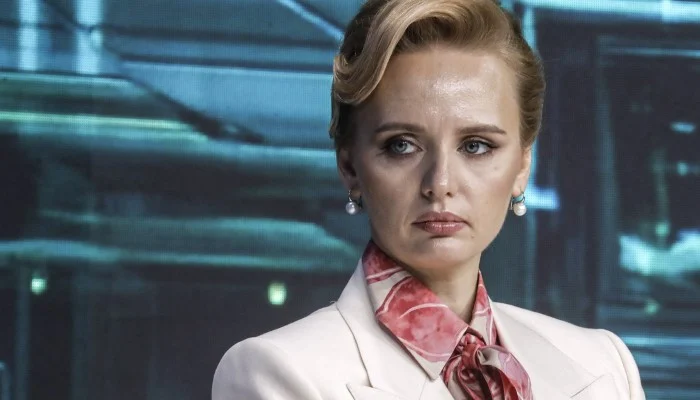

Alina Kabaeva, the Olympic gymnastics champion believed to be President Vladimir Putin’s longtime partner, has largely led a private life for many years. Reports even suggest that she watches her and Putin’s children play hockey from behind an opaque glass screen to maintain her secrecy. However, this month marked a significant shift, as Kabaeva was appointed the new head coach of Russia’s national rhythmic gymnastics team following the unexpected resignation of Irina Viner, the long-standing coach who had previously guided Kabaeva to Olympic gold in 2004.
Kabaeva’s ascension to the role of coach is part of a larger trend of women close to Putin, who had previously stayed out of the spotlight, slowly emerging into public view. This move comes after Kabaeva was sanctioned by Western nations in 2022 as part of measures against Russia’s elite figures following the invasion of Ukraine.
In recent months, Kabaeva’s public profile has gradually shifted. In the fall of 2024, she founded Nebesnaya Gratsiya (Sky Grace), an international association for rhythmic gymnastics clubs, with a club bearing the same name opening in Sochi—reportedly at Putin’s personal initiative. State-owned Gazprom even contributed over $20 million, gifting the club a building valued at more than 2 billion rubles. Since then, Kabaeva has been increasingly visible, taking an active role in training gymnasts, and the Russian rhythmic gymnastics federation now requires her club’s approval for any changes to the sport’s regulations.
Kabaeva’s rise to power has sometimes put her at odds with her former coach, Viner, especially as Kabaeva’s club has gained significant influence within Russian rhythmic gymnastics. The restructuring of the governing body in October 2024 followed Viner’s resignation and further exemplified Kabaeva’s growing prominence.
Meanwhile, other women linked to Putin have also started to appear more publicly. His daughters, Maria Vorontsova and Katerina Tikhonova, widely believed to be his children with ex-wife Lyudmila, have made rare public appearances, though Putin has never formally acknowledged them. Vorontsova, an endocrinologist, made a notable appearance in January 2024 at a school event hosted by Moscow State University. She described Russia as a “human-centered” society and named authors like Pushkin and Dostoevsky among her favorites. Later in June, both Vorontsova and Tikhonova were seen at the St. Petersburg International Economic Forum (SPIEF), with Tikhonova, who heads the development company Innopraktika, also known for her acrobatic rock’n’roll competitions.
There have been some sensational reports about Vorontsova, including claims that she traveled to the Ukrainian frontlines to treat wounded soldiers—a story that was later debunked. This tale seemed to be designed to boost her image among pro-war Russians, portraying her as a heroic figure aiding the war effort.
Another figure, Elizaveta Krivonogikh, the 21-year-old daughter of Putin and Svetlana Krivonogikh, a former cleaner turned bank owner, has also gained attention. Known by her social media name, Luiza Rozova, Krivonogikh was active on Instagram until she abruptly deleted her account following the invasion of Ukraine. Reports suggest she is currently studying in Paris, despite Western sanctions imposed on her father.
Further, Anna Tsivilyova, identified by the West as a “close relative” of Putin, was appointed deputy defense minister following significant changes within Russia’s military leadership last year.
Liza Fokht, a BBC Russian service journalist, noted that the increasing visibility of Putin’s family members highlights how the war in Ukraine has reshaped the lives of Russia’s political elite. In addition to Putin’s family, the war has led to the rise of various relatives of key Russian elites to prominent roles. Among them are Boris Kovalchuk, son of Yury Kovalchuk, Dmitry Patrushev, son of Nikolai Patrushev, and Sergei Tsivilyova, husband of Anna Tsivilyova.
Despite growing international pressure, the ongoing conflict has allowed these figures to move more freely in the public eye, with little regard for public opinion. As Fokht pointed out, “the appointment of Putin’s first cousin once removed as deputy defense minister might be seen as nepotism, but who has time to worry about corruption amid Russia’s confrontation with the West and the retaking of cities in the Donbas?”
The visibility of Putin’s inner circle is now greater than ever, as they increasingly take on roles in the public eye, marking a new phase for Russia’s elite.
