

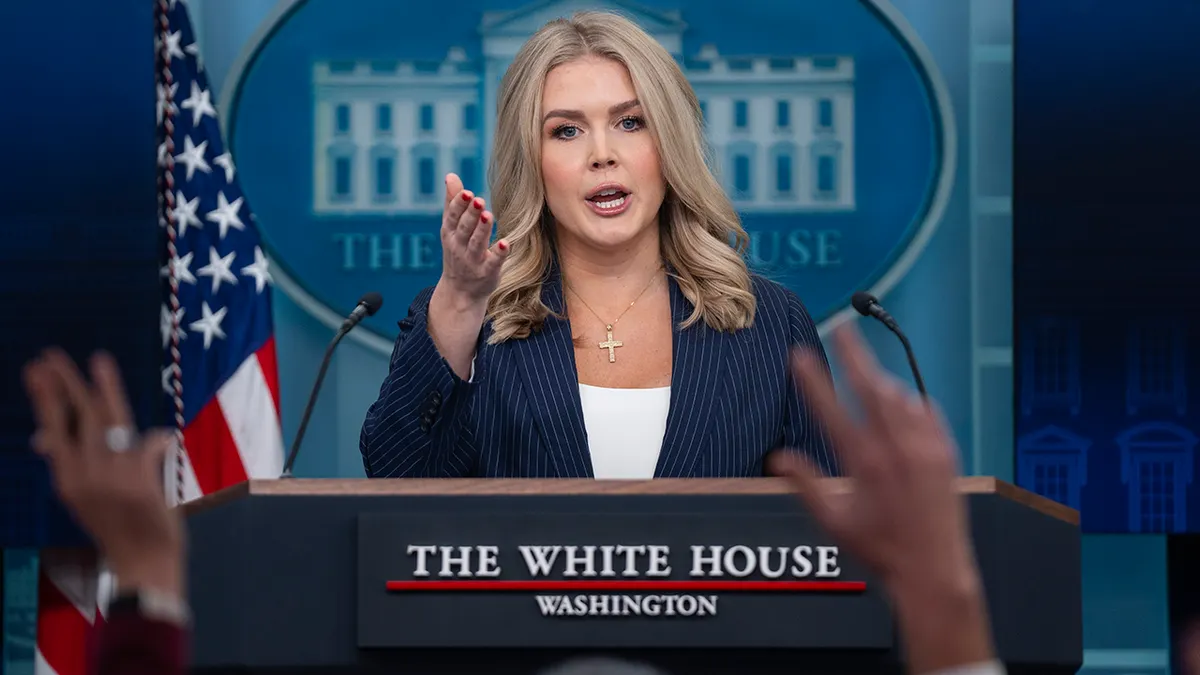

At 27, Karoline Leavitt made history as the youngest White House press secretary, vowing to uphold Donald Trump’s “revolutionary media approach.” Within weeks, she delivered on that promise, igniting one of the most intense confrontations between the presidency and journalists in recent history.
On Tuesday, Leavitt shocked the press corps by announcing that the White House—not the independent White House Correspondents’ Association—would now decide which reporters gain access to the Oval Office and Air Force One. “The association has long controlled who gets to question the president in these intimate spaces. Not anymore,” she declared.
A longtime Trump loyalist and former spokesperson for his 2024 campaign, Leavitt set a combative tone from her first briefing on January 29. She accused mainstream media of spreading “lies,” introduced a “new media” seat for podcasters, and opened press credential applications, receiving over 12,000 inquiries.
Leavitt frequently prioritizes right-wing outlets in press briefings, asserting they were sidelined under Joe Biden’s administration. However, she also fields questions from traditional media, though she often cuts them off before follow-ups—an established White House practice.
Despite her growing role in shaping media relations, Leavitt ensures she does not overshadow Trump, who engages with reporters almost daily. She has held only a few briefings and primarily appears on conservative platforms like Fox News. She has repeatedly described Trump as the “most transparent president in history,” while positioning herself as a key enforcer in the administration’s battle over press access.
Leavitt faced legal challenges when she was named in a lawsuit after a news outlet was barred from events for refusing to refer to the Gulf of Mexico as the “Gulf of America,” per a Trump executive order. She defended the decision, insisting the new name was “fact” despite international opposition.
Born in New Hampshire, Leavitt’s political allegiance to Trump dates back to her college years when she criticized a professor for speaking against him. She later worked in his first administration and ran unsuccessfully for Congress in 2022 on a pro-Trump, pro-gun platform. Her unwavering commitment was evident during Trump’s 2024 campaign, where she became known for her sharp media appearances.
Even after giving birth, she returned to work just four days later when Trump survived an assassination attempt. “I looked at my husband and said, ‘Looks like I’m going back to work,’” she recalled. Her dedication has earned her praise within Trump’s circle, cementing her position as a rising force in conservative politics.
