

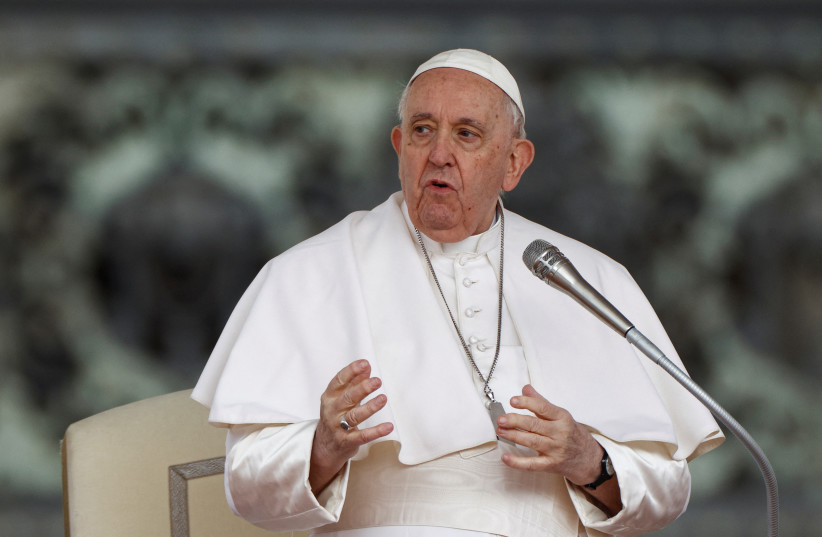

Pope Francis remains in critical condition as he battles double pneumonia, but he was described as alert and having had a “tranquil” night following a respiratory crisis and blood transfusions, the Vatican reported on Sunday.
The 88-year-old pontiff was admitted to Rome’s Gemelli hospital on February 14 after experiencing breathing difficulties. He was subsequently diagnosed with pneumonia in both lungs. The Vatican had previously reported his condition as critical on Saturday, revealing that the pope required supplemental oxygen and blood transfusions after a prolonged asthma-like respiratory crisis.
On Sunday morning, the Vatican issued a brief update stating that “the night was tranquil, and the pope rested,” though they did not provide further details. A Vatican official, speaking on the condition of anonymity, confirmed that Francis was awake and alert on Sunday. The pope was receiving oxygen as needed via a small tube, but was breathing unaided, the official added.
A more detailed update is expected later in the day after further clinical exams.
Unable to deliver his usual Sunday prayer in St. Peter’s Square for the second week in a row, Pope Francis expressed in a written message that he was continuing with his hospital treatment “confidently.” He thanked his doctors and expressed gratitude for the messages of support from well-wishers.
Archbishop Rino Fisichella urged participants at Mass in St. Peter’s Basilica to intensify their prayers for the pope’s recovery. The Diocese of Rome also announced a special Mass on Sunday evening to pray for Francis, asking for “the strength necessary to get through this moment of trial.”
Double pneumonia is a severe condition that causes inflammation and scarring in both lungs, making breathing difficult. The Vatican has called the pope’s infection “complex,” attributing it to the presence of multiple microorganisms.
Pope Francis, who has served as pontiff since 2013, has experienced health issues in recent years, including lung infections due to pleurisy, a condition he developed as a young adult. He also had part of one lung removed.
In Rome, pilgrims gathered to pray for the pope’s health, expressing deep concern for his condition. “I am very, very sad,” said Elvira Romana from Italy. “I don’t know how you can continue normally at this moment.” Matteo Licari from Sardinia added, “Let’s hope he can keep living. We are waiting for him to come back here.”
Outside Gemelli Hospital, people gathered to pray near a statue of the late Pope John Paul II, who was treated at the same facility numerous times during his papacy. Visitors left flowers, notes, and lit candles in tribute to Pope Francis.
The Vatican also noted that the pope’s respiratory crisis had required “high-flow oxygen” and that his low platelet count, linked to anemia, had necessitated blood transfusions. Two of his doctors indicated that the pope’s age and frailty make him particularly vulnerable. Dr. Sergio Alfieri, a senior member of the Gemelli hospital staff, warned that the lung infection could spread to his bloodstream and result in sepsis, which could be difficult to treat.
