

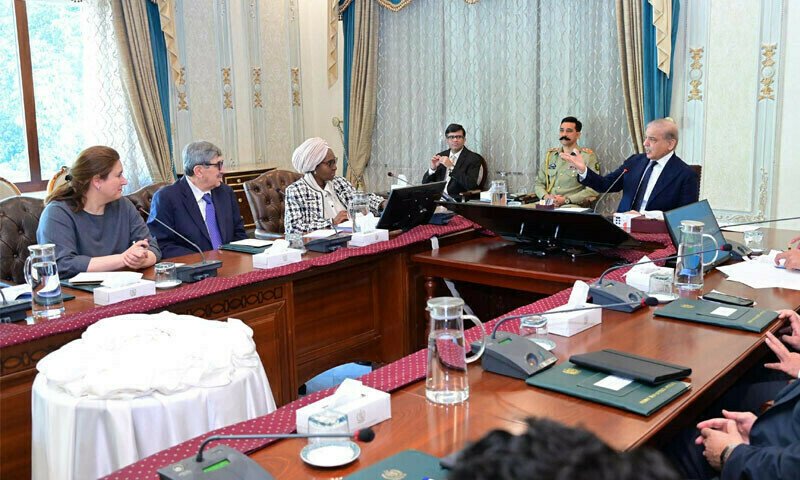

PM Shehbaz Expresses Gratitude, Calls It a Major Milestone for Economic Growth
Prime Minister Shehbaz Sharif has expressed his deep gratitude for the World Bank’s commitment of $40 billion in investment for Pakistan, calling it a key step toward the country’s economic stability and growth.
During a meeting with a delegation of World Bank Executive Directors, the Prime Minister welcomed their visit and underscored the long-standing seven-decade partnership between Pakistan and the global lender. He acknowledged the World Bank’s vital role in supporting major infrastructure and development initiatives across the country.
A Multi-Sector Investment for Progress
The $40 billion investment, which is part of the World Bank’s Country Partnership Framework (CPF), will be allocated as follows:
- $20 billion dedicated to health, education, youth development, and other social sectors, aimed at fostering long-term progress.
- $20 billion under the International Finance Corporation (IFC) to strengthen Pakistan’s private sector, drive economic growth, and create jobs.
Prime Minister Shehbaz Sharif praised the World Bank’s support during the 2022 floods, which helped millions of affected Pakistanis. He emphasized that Pakistan’s institutional and economic reforms are progressing rapidly, with a clear vision for sustainable growth.
Economic Reforms and Transparency
The Prime Minister also highlighted improvements in exports, remittances, and investment inflows, coupled with lower interest rates, which are encouraging industrial growth. He reaffirmed the government’s commitment to transparency, particularly through digital reforms in the Federal Board of Revenue (FBR) and structural changes in the power sector aimed at ensuring a reliable electricity supply and reducing financial losses.
Additionally, PM Shehbaz mentioned the Special Investment Facilitation Council (SIFC), which aims to provide an attractive, stable investment environment in Pakistan by focusing on partnerships rather than loans.
The nine-member delegation of World Bank Executive Directors commended Pakistan’s ongoing economic reforms and policy initiatives. They acknowledged the government’s efforts in energy, industry, exports, privatization, and revenue collection, noting that these measures were already yielding positive results.
First High-Level Visit in Two Decades
This visit marks the first high-level delegation from the World Bank to visit Pakistan in 20 years. The delegation, representing 88 countries, is here to assess the implementation of the $40 billion Country Partnership Framework and to explore additional economic opportunities.
During their stay, they will meet with PM Shehbaz Sharif, the Minister for Finance, the Minister for Economic Affairs, and the Minister for Planning, to discuss Pakistan’s economic outlook, investment potential, and infrastructure development. The delegation will also visit Khyber Pakhtunkhwa, Sindh, and Punjab, engaging with business leaders, academics, and civil society representatives to evaluate local development challenges and opportunities.
Global Recognition
Sources indicate that the CPF model designed for Pakistan has garnered significant attention at the World Bank headquarters, with other countries considering it as a potential blueprint for economic stability and growth.
The visit highlights Pakistan’s strengthening ties with global financial institutions, ensuring long-term investment, economic development, and infrastructure improvements. The $40 billion commitment solidifies the World Bank’s enduring economic partnership with Pakistan, paving the way for sustainable growth.
World Bank Delegation Members:
- Abdul Haq Bedjaoui (Algeria)
- Zanib Ahmed (Nigeria, representing South Africa and Angola)
- Beatrice Maser (Switzerland, representing Central Asia and Switzerland)
- Robert Bruce Nicholl (Australia, representing 14 countries including South Korea, New Zealand, and Australia)
- Teresa Solbes (Spain, representing seven countries in South America including Mexico and Costa Rica)
- Paul Bonmartin (France)
- Lonkhululeko Magagula (Eswatini, representing 21 African countries including Tanzania, Zimbabwe, Kenya, and Ethiopia)
- Marlene Suzie Nzengou (Central African Republic, representing 23 African nations)
- Tauqir Shah (Executive Director representing Pakistan and seven other countries)
