

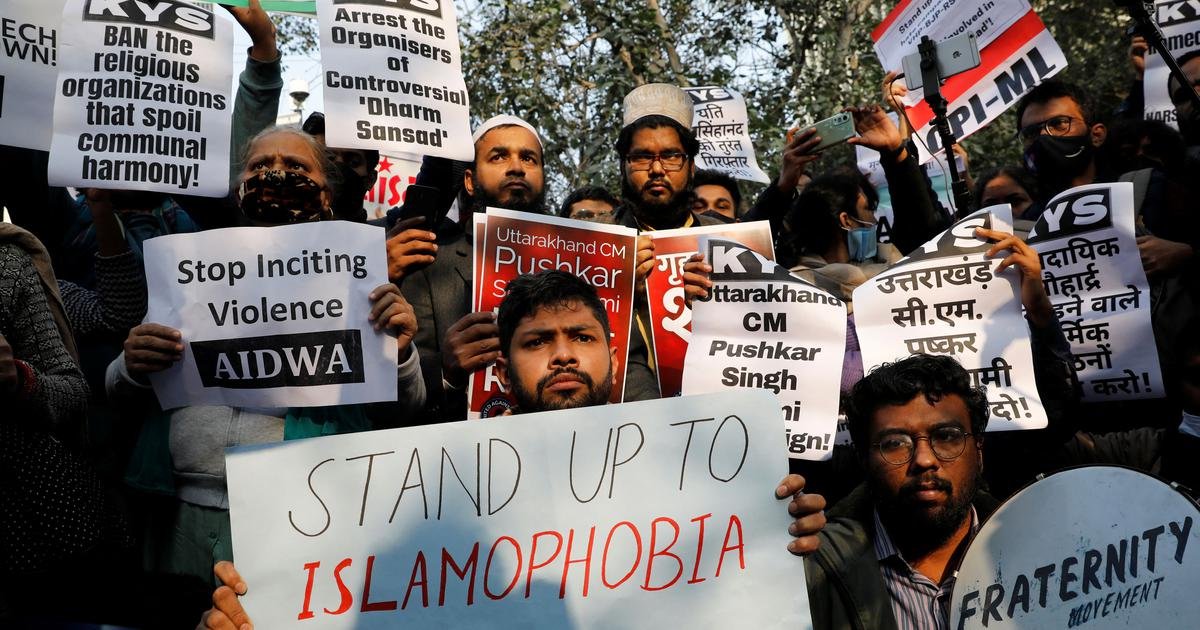

Instances of hate speech targeting minorities in India, particularly Muslims, increased by 74% in 2024, according to a report released Monday by a Washington-based research group, India Hate Lab. The rise in hate speech incidents coincided with last year’s national elections, with the majority of cases occurring at political rallies, religious processions, protest marches, and cultural gatherings.
India Hate Lab documented 1,165 instances of hate speech in 2024, compared to 668 in the previous year. The group highlighted that the general election year, which saw polling take place in seven phases from April 19 to June 1, played a significant role in the surge of hate speech incidents.
The report comes just days before a White House meeting between U.S. President Joe Biden and Indian Prime Minister Narendra Modi, whose government has faced criticism from rights groups, including Human Rights Watch and Amnesty International, for its treatment of minorities.
Modi’s government has denied accusations of discrimination, arguing that policies such as food subsidies and electrification benefit all citizens.
India Hate Lab noted that a third of the hate speech incidents occurred between March 16 and June 1, during the peak of the election campaign, with May marking a particularly intense period. The group also pointed to remarks made by Modi in April, in which he referred to Muslims as “infiltrators” with “more children.”
Despite winning a third consecutive term, Modi’s Bharatiya Janata Party (BJP) failed to secure a majority, relying on coalition partners to form a government. India Hate Lab reported that 80% of hate speech incidents in 2024 occurred in states governed by the BJP and its allies.
The group, founded by Kashmiri journalist Raqib Hameed Naik, is part of the Center for the Study of Organized Hate, a Washington-based nonprofit think tank. The BJP has criticized the group, claiming its report offers a biased view of India.
Rights advocates point to a range of controversial policies, including the 2019 Citizenship Amendment Act, which the UN called “fundamentally discriminatory,” anti-conversion laws, and the revocation of the special status of Muslim-majority Jammu and Kashmir. They also highlight the demolition of properties owned by Muslims, bans on hijabs in schools, and other actions that critics say target minority communities.
India Hate Lab defines hate speech according to the UN’s criteria, encompassing prejudiced or discriminatory language based on attributes such as religion, ethnicity, nationality, race, or gender.
