

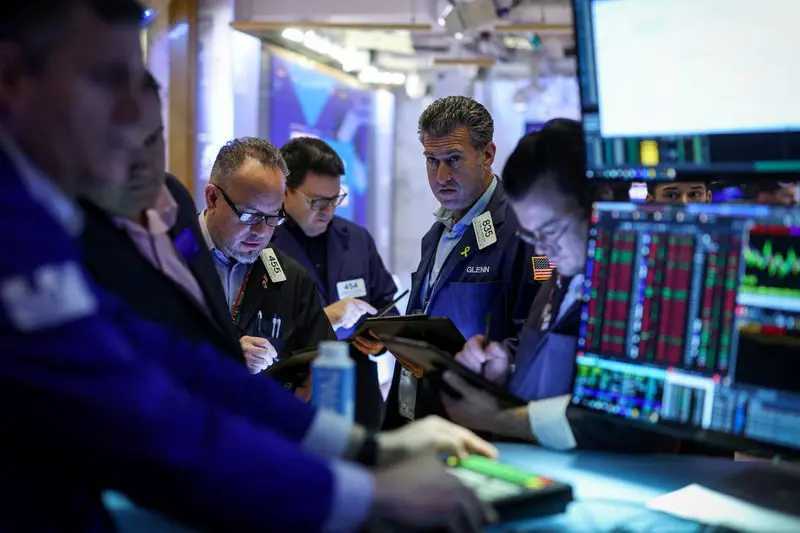

Global markets reacted swiftly to U.S. President Donald Trump’s sudden suspension of impending tariffs, with investors adjusting to the ebb and flow of trade policy changes.
Hong Kong’s stock market hit a two-month high, and U.S. equity futures rose by 0.4% on Tuesday. The dollar fluctuated significantly, reversing initial gains against Mexico’s peso and the Canadian dollar after Trump’s decision to delay tariffs in exchange for stronger border enforcement measures.
The euro experienced a wild ride, dipping to $1.0125 before rebounding to $1.0320 within 24 hours, as Trump’s dealmaking suggested that trade policies remain in flux and open for negotiation.
In Hong Kong, the Hang Seng index rose by 2.5%, despite the looming 10% tariff set to hit Chinese goods. Electric vehicle makers led the charge, with Li Auto’s stock soaring by 8% and semiconductor giant SMIC seeing a more than 7% increase, reaching a record high.
Steven Leung, institutional trading manager at UOB-Kay Hian in Hong Kong, noted that Trump’s strategy—threatening tariffs but leaving room for negotiation—suggests that the policy is still not firmly set. “It’s not a very firm policy yet. No need to worry too much,” Leung commented.
European equity futures saw a modest rise of 0.2%, while oil prices, which had spiked, dipped to $75.46 per barrel, nearing a one-month low. Bitcoin, which had dropped to around $91,000, recovered to about $102,000.
Ross Mayfield, an investment strategist at Baird in Louisville, Kentucky, explained that the ongoing fluctuations are part of a “rollercoaster” of public negotiation around tariffs and policies, which investors should get used to.
In the Asia-Pacific region, Australian shares rose by 0.4%, and Japanese stocks gained 1.7%, though the gains were smaller compared to Monday’s losses, as concerns over a trade war still loomed.
Trump’s press secretary confirmed that the president will speak with Chinese President Xi Jinping in the coming days. Although Chinese markets remain closed for the Lunar New Year, the offshore yuan strengthened to 7.3112 per dollar from a low of 7.3765.
The Australian dollar recovered to $0.6206, after having dropped to $0.6088 on Monday, while the Japanese yen, typically seen as a safe haven, eased 0.3% to 155.18 per dollar.
Gold, which hit record highs on Monday due to fears of a global trade war, remained near those levels, trading at $2,813 an ounce on Tuesday. Treasury futures ticked slightly lower, with markets divided on whether the U.S. Federal Reserve will implement one or two rate cuts this year.
J.P. Morgan’s chief U.S. economist, Michael Feroli, warned that the uncertainty caused by these developments will be hard to reverse. “For the Fed, the weekend’s developments will likely reinforce their inclination to remain on the sidelines and avoid drawing attention,” he said.
