

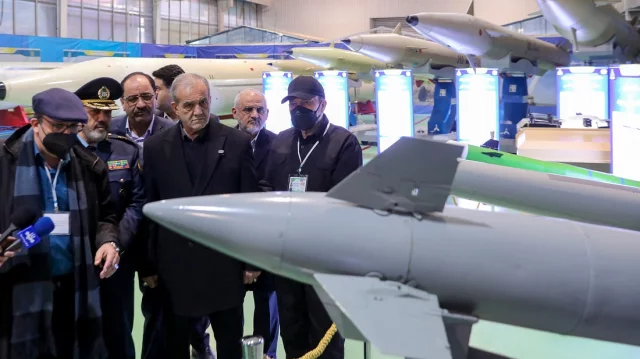

Iran revealed a new ballistic missile on Sunday, showcasing its growing military capabilities. The missile, named Etemad—meaning “trust” in Persian—was unveiled at a ceremony in Tehran attended by President Masoud Pezeshkian. State television aired images of the missile, highlighting its 1,700-kilometre range and branding it as “the most recent ballistic missile” developed by Iran’s defense ministry.
The unveiling has raised concerns among Western countries, which view Iran’s advancements in missile technology as destabilizing for the Middle East. With a range that includes Israel, Iran’s missiles, including the newly introduced Etemad, are seen as a significant threat. Last year, Iran targeted Israel twice during the Gaza conflict.
During the ceremony, President Pezeshkian stated, “The development of defense capabilities and space technologies aims to ensure that no country dares to attack Iranian territory.” The event also featured the presentation of three domestically produced satellites, including a 34-kilogram communications satellite, Navak, and updated versions of the Pars-1 and Pars-2 imaging satellites. These satellites are used for monitoring the environment, emergency situations, and urban management, according to the official IRNA news agency.
The unveiling coincided with Iran’s National Aerospace Day and was held just days before the 46th anniversary of the 1979 Islamic Revolution on February 10.
In recent years, particularly since the return of U.S. President Donald Trump, Iran has made several military displays, including large-scale exercises and the reveal of underground military bases, as part of its “maximum pressure” response to U.S. policies. Just the day before, Iran also showcased the Ghadr-380, a new cruise missile with “anti-jamming capabilities” and a range of over 1,000 kilometres.
Despite these demonstrations of military power, Tehran has expressed a willingness to resume negotiations on its nuclear program, which has been a source of tension with Western nations for decades.
Once heavily reliant on U.S. military equipment, Iran has developed a substantial stockpile of domestically produced weapons, including missiles, air defense systems, and drones, due to the arms embargoes and sanctions imposed after the 1979 revolution and subsequent conflicts, including the war with Iraq from 1980 to 1988.
