

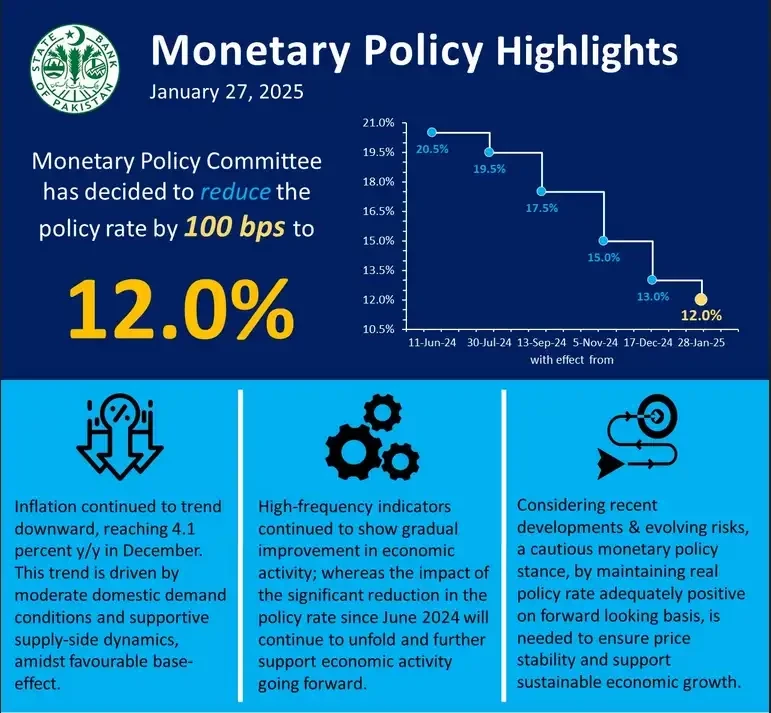

The State Bank of Pakistan (SBP) announced its first monetary policy rate of the year on Monday, revealing a 100 basis point reduction in the policy rate, bringing it down from 13% to 12%. This marks the sixth consecutive cut in the policy rate.
SBP Governor Jameel Ahmed addressed a press conference in Karachi, stating, “The Monetary Policy Committee (MPC), after thorough deliberation, has decided to lower the policy rate by 100 basis points, from 13% to 12%.”
The governor highlighted that the rate reduction was driven by positive economic indicators, including inflation trends and improvements in the current and external accounts. He also projected inflation to reach 4.1% by December 2024. In a significant development, the current account surplus for December 2024 stood at $582 million, a sharp improvement from the previous deficit.
For the first half of the fiscal year, the country reported a current account deficit of $1.021 billion, while total foreign exchange reserves reached $16.19 billion. Inflation is expected to continue easing in January before gradually rising in the following months, according to the governor.
While core inflation remains elevated, the committee noted that economic activity continues to show gradual improvement. The governor emphasized that the 1,000 basis point reduction in the policy rate since June 2024 will continue to support the economy.
Despite a slight dip in real GDP growth during Q1 of FY25, the current account remained in surplus in December 2024. However, foreign exchange reserves fell due to low financial inflows and high debt repayments. Tax revenues, though increasing, remained below target during the first half of FY25. Additionally, global oil prices have exhibited volatility, which has led central banks globally to adopt more cautious approaches.
Given these circumstances, the MPC agreed on the need for a cautious monetary policy to maintain price stability, which is vital for sustainable economic growth. The committee also emphasized that the real policy rate should remain sufficiently positive to stabilize inflation within the target range of 5-7%.
Governor Ahmed explained that if agricultural growth had been closer to last year’s levels, the real GDP growth rate in Q1 could have exceeded 2%. He pointed out that the policy rate has decreased by 10 percentage points over the last six to seven months, from 22% to 12%, and its effects are becoming evident in the economy.
Real Sector Performance
The MPC noted that the decline in large-scale manufacturing has been mainly driven by a few low-weight sectors, such as furniture. However, key industries like textiles, food and beverages, and automobiles have seen notable improvements. Furthermore, business confidence remains positive.
Looking ahead, the MPC expects economic activity to gain momentum, with real GDP growth projected to remain in the range of 2.5% to 3.5% for FY25.
External Sector Developments
The current account posted a surplus of $582 million in December, bringing the total surplus for H1-FY25 to $1.2 billion. The outlook for the current account has significantly improved, and it is now expected to remain close to balance in FY25. Although financial inflows were low in the first half of FY25, they are expected to pick up as a substantial portion of official debt repayments has already been made. The improved outlook for the current account, coupled with planned financial inflows, is likely to increase SBP’s foreign exchange reserves above $13 billion by June 2025.
Fiscal Sector Outlook
The Federal Board of Revenue (FBR) saw a 26% increase in revenue during H1-FY25. However, the tax collection shortfall from the target widened. The committee noted that lower-than-expected interest payments could help keep the fiscal deficit within target. Nevertheless, achieving the primary balance target remains challenging.
Money and Credit
Broad money (M2) growth slowed to 11.3% year-on-year as of January 17, compared to 13.3% at the time of the previous MPC meeting. This slowdown was primarily due to a deceleration in the growth of net domestic assets (NDA). While government borrowing from the banking system remained contained, there was a sharp increase in banks’ credit to the private sector, driven by the ongoing economic recovery and easier financial conditions.
Inflation Trends
Headline inflation continued its downward trend, easing to 4.1% year-on-year in December from 4.9% in November. This decline was primarily due to lower electricity tariffs, a stable supply of key food items, stable exchange rates, and favorable base effects.
The MPC reiterated its expectation that inflation would remain volatile in the near term, with the possibility of rising towards the upper bound of the target range by the end of FY25.
